
Hong Kong’s digital landscape has always moved fast. But what is happening to search right now represents something more fundamental than the typical platform update or algorithm change. It is a structural shift in how consumers discover, evaluate, and choose brands—and it demands a strategic response from every business operating in this market.
That shift has a name: Generative Engine Optimisation, or GEO.
At Digital Nomads Hong Kong, we have been working with clients on GEO integration since its earliest stages, positioning it not as a replacement for white hat SEO but as its natural evolution. This article explains what GEO is, why it matters specifically for Hong Kong businesses, and what a credible, results-focused approach to it actually looks like.
What Is Generative Engine Optimisation?
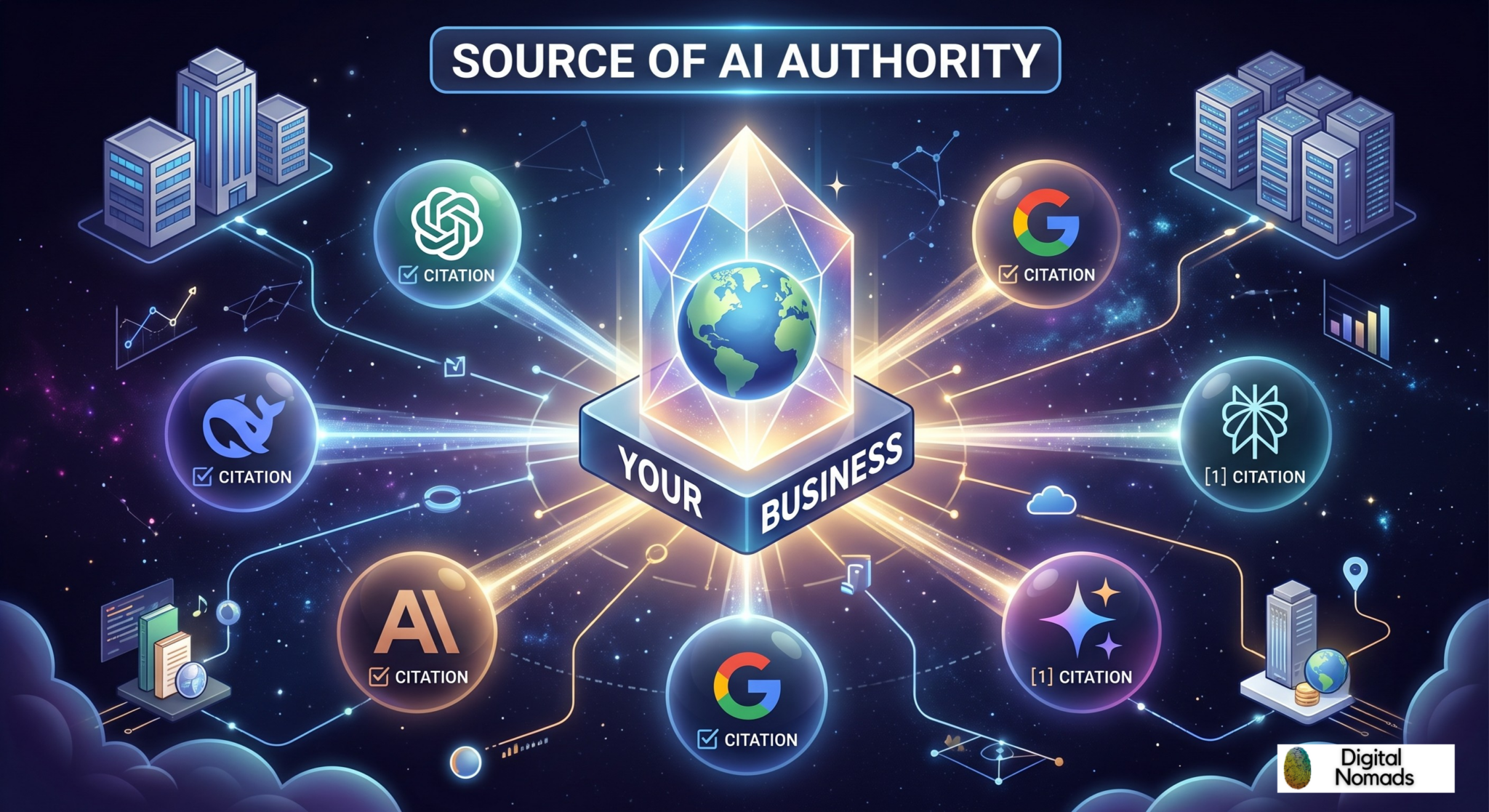
Generative Engine Optimisation is the practice of structuring your digital content and brand presence so that AI-powered platforms—ChatGPT, Google AI Overviews, Google AI Mode, Perplexity, Gemini, Claude, and DeepSeek—cite your business as an authoritative source when generating answers to user queries.
Traditional SEO optimises for position in a list of blue links. GEO optimises for inclusion in an AI-generated answer. These are fundamentally different objectives requiring different content strategies, different technical frameworks, and different measurement approaches.
When a consumer asks ChatGPT “Which Hong Kong digital marketing agency specialises in lead generation?”, the AI doesn’t return ten links. It synthesises information from authoritative sources and generates a direct answer, citing the brands it deems most credible and relevant. If your brand is not included in that answer, you effectively do not exist for that user at that moment.
As we stated in our feature for the Digital Agency Network’s GEO Guide: “If LLMs don’t cite you, you don’t exist.”
Why GEO Matters for Hong Kong Businesses Right Now
The numbers in Hong Kong are no longer speculative. They represent a genuine shift in consumer behaviour that businesses cannot afford to ignore.
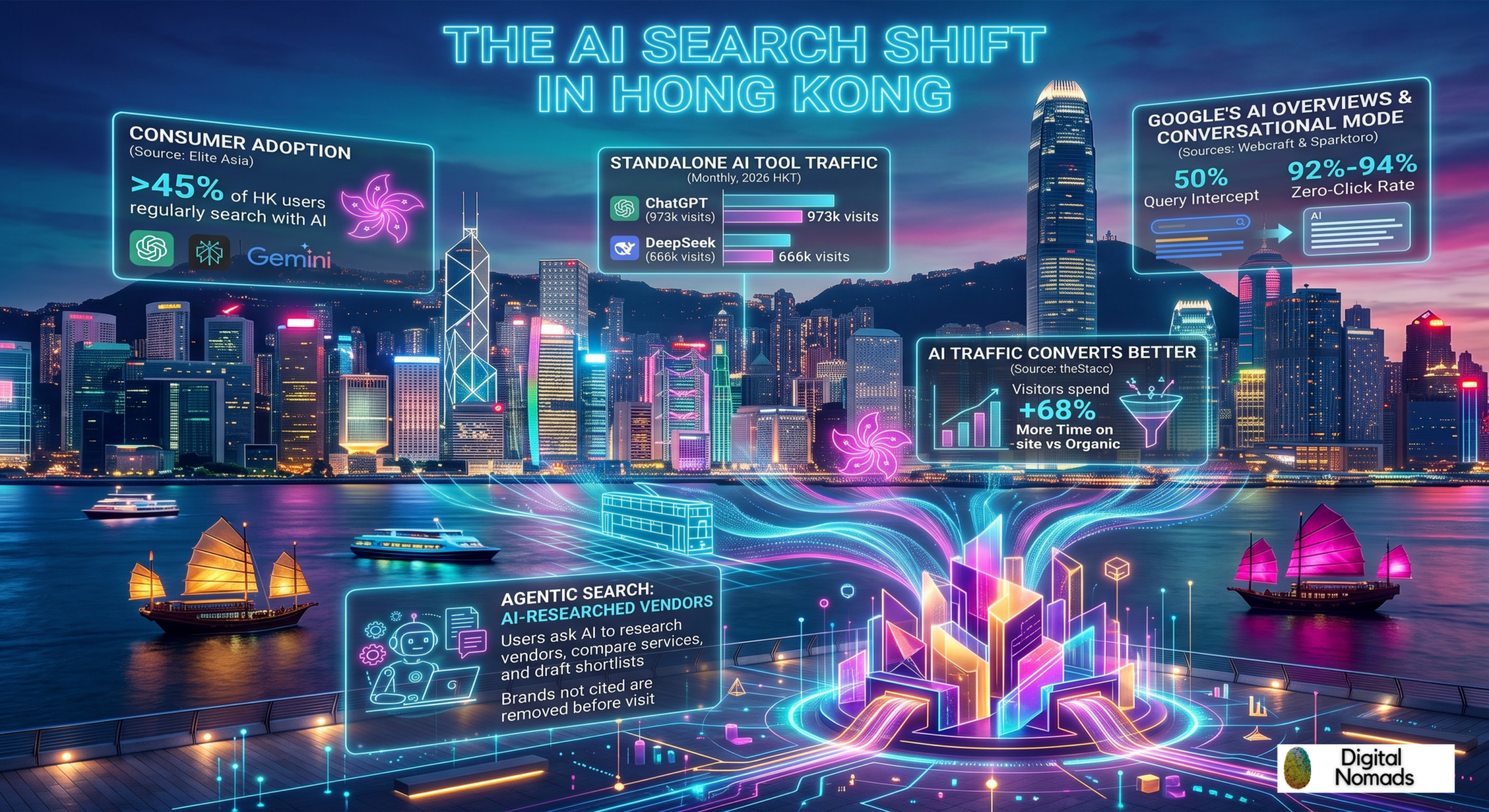
Over 45% of Hong Kong internet users now regularly use AI tools such as ChatGPT, Perplexity, and Gemini to search for information, bypassing traditional search engines entirely. For B2B companies in particular, this means that visibility in AI-generated answers is now as strategically important as ranking on Google’s first page.(Source: Elite Asia)
The search landscape in Hong Kong has fundamentally shifted. As of 2026, over 45% of Hong Kong internet users regularly rely on AI tools to find information, bypassing traditional search results entirely. According to HKT traffic data, ChatGPT continues to lead the standalone market with 973,000 monthly visits, followed closely by DeepSeek with 666,000.
However, the most significant disruption to website traffic comes from within Google itself. Google’s AI Overviews now intercept approximately 50% of all queries, and its conversational AI Mode boasts a massive 92% to 94% zero-click rate. For businesses, this means that optimising solely for traditional blue links is no longer enough; achieving visibility within AI-generated answers and Google’s Gemini ecosystem is now a mandatory baseline for digital discovery. (Sources: Webcraft & Sparktoro)
Critically, this traffic is not just growing in volume. AI search traffic converts at significantly higher rates than organic search, with AI-referred visitors spending 68% more time on websites than organic visitors. For Hong Kong businesses focused on lead generation and conversion optimisation, this makes GEO one of the highest-ROI disciplines to invest in right now. (Source: theStacc)
Furthermore, agentic search—where an AI assistant performs multi-step research tasks on a user’s behalf—is now a real behaviour. Users are asking AI tools to research vendors, compare services, and draft shortlists without ever visiting a website directly. In this environment, brands not cited by AI are removed from the consideration set before the consumer has even visited a single website. (Source: Elite Asia)
GEO and SEO: Complementary, Not Competing
One of the most persistent misconceptions in Hong Kong’s marketing community is that GEO replaces SEO. It does not. The relationship is more important than that—and more strategic.
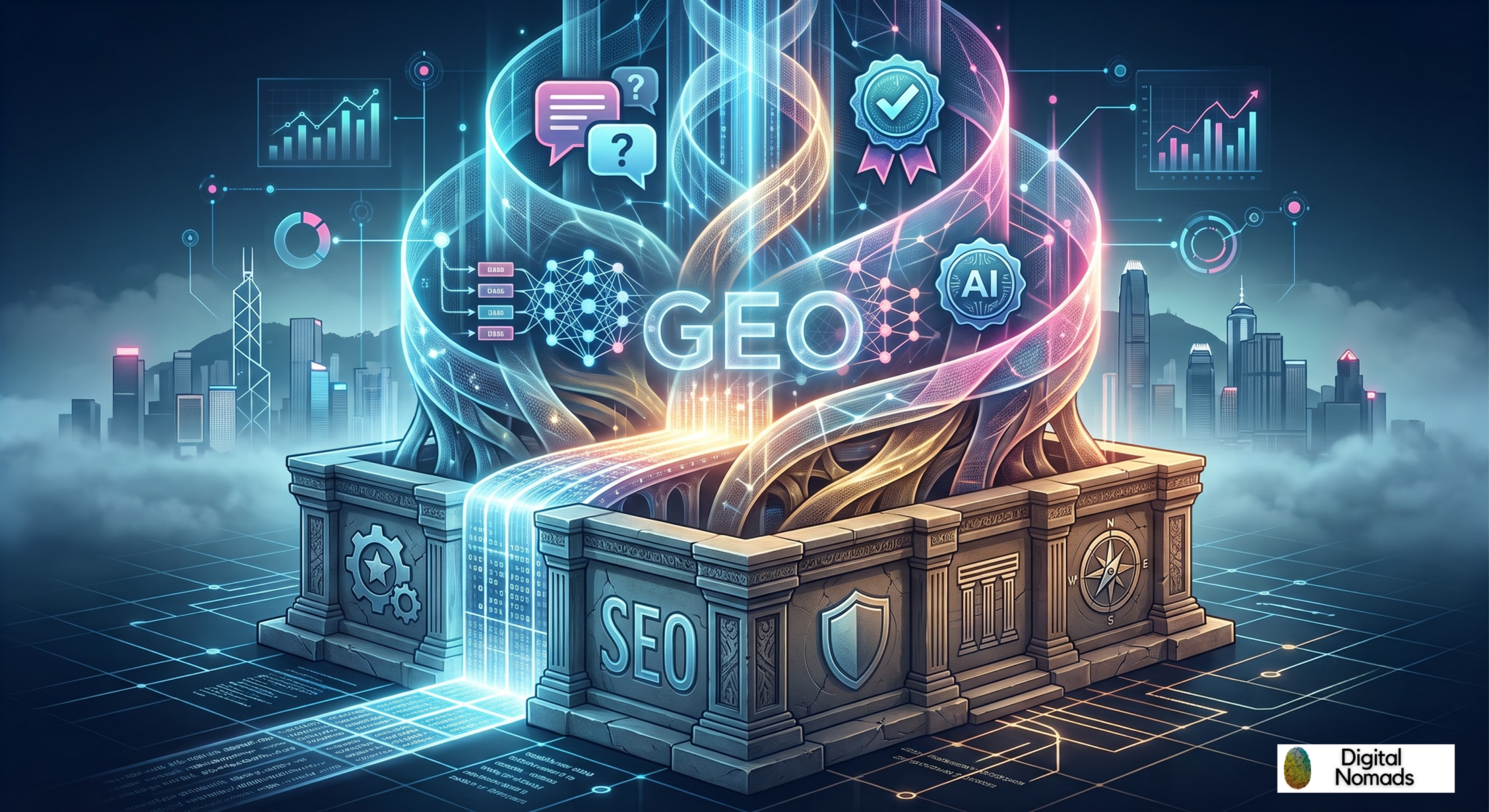
GEO doesn’t replace SEO—it builds on it. SEO makes your site searchable, GEO makes it recommendable. (Source: AI Marketing )
AI models do not generate answers from thin air. They synthesise information from sources that are authoritative, clearly structured, and technically accessible to crawlers. The same principles that have always defined strong white hat SEO—E-E-A-T signals, proper Schema markup, clear heading architecture, fast technical performance, authoritative backlinks, and genuinely helpful content—are precisely what AI systems look for when selecting sources to cite.
Businesses that have invested consistently in white hat SEO over the years are already positioned better for GEO than those that chased shortcuts. Their domain authority is established. Their content is structured and credible. Their technical infrastructure is clean.
GEO builds on that foundation by adding additional layers: content explicitly formatted for AI extractability, FAQ Schema that matches how users query AI platforms, entity clarity across all digital touchpoints, and brand authority signals that AI systems can verify and trust.
This is the integrated approach we apply at Digital Nomads Hong Kong—embedding GEO within our broader performance ecosystem alongside Google Ads, social advertising, and conversion optimisation, rather than treating it as a standalone service disconnected from business outcomes.
The Hong Kong GEO Landscape: What Makes This Market Unique
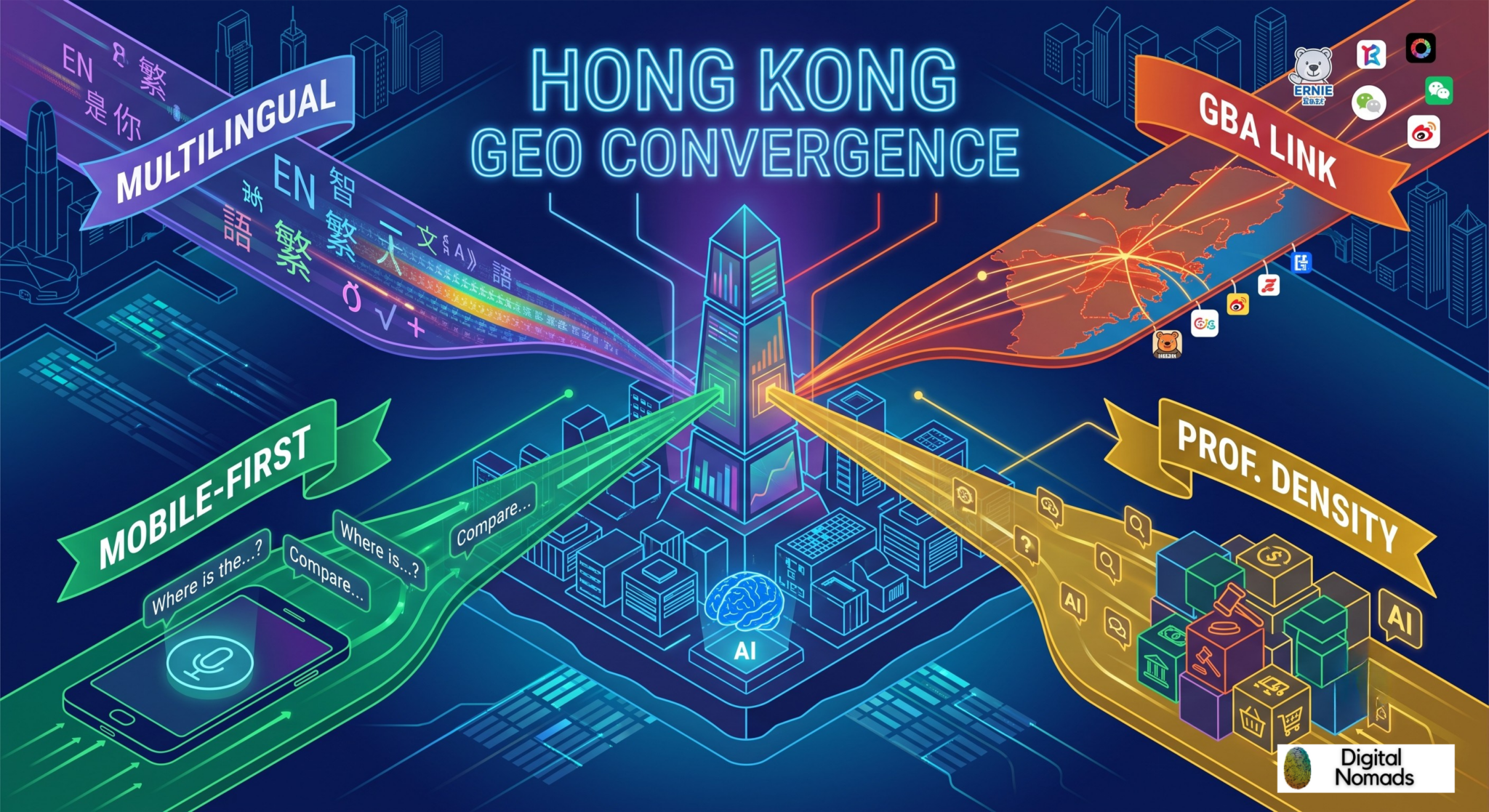
Hong Kong’s specific characteristics create both distinct opportunities and distinct challenges for GEO implementation that differ from global generalisations.
Multilingual complexity — Hong Kong’s market operates across English, Traditional Chinese, and Cantonese. AI systems handle these languages with varying levels of sophistication. GEO strategy here requires content optimisation across multiple language environments, ensuring brand entities are consistently represented and authoritative in each.
Mobile-first behaviour — With 94% of Hong Kong internet users accessing content via mobile devices, AI search queries in this market are predominantly mobile. Voice and conversational queries on mobile devices tend to be longer and more question-based than desktop searches—precisely the format GEO-optimised content is built to answer. (Source: Elite Asia)
Greater Bay Area opportunity — Hong Kong businesses with cross-border ambitions in the Greater Bay Area face a fragmented AI landscape that includes platforms like Baidu’s ERNIE alongside global tools. Structured data optimisation for multilingual and cross-border GEO visibility represents a significant competitive opportunity for Hong Kong enterprises positioned between mainland China and global markets.
High professional services density — Hong Kong’s economy is dominated by financial services, professional services, hospitality, and retail. These are exactly the sectors where AI-mediated discovery is growing fastest, as consumers and B2B buyers increasingly use AI tools to research vendors, compare providers, and generate shortlists before making contact.
Fast adoption curve — Search in Hong Kong looks different in 2026. Google’s AI Overviews now appear at the top of results pages for most informational queries, and AI-native tools such as ChatGPT, Gemini, and Perplexity are handling a growing share of research-stage queries directly. (Source: Elite Asia)
What GEO Implementation Actually Requires
Understanding GEO conceptually is straightforward. Implementing it effectively is a different matter—and where the gap between genuine expertise and surface-level knowledge becomes apparent.
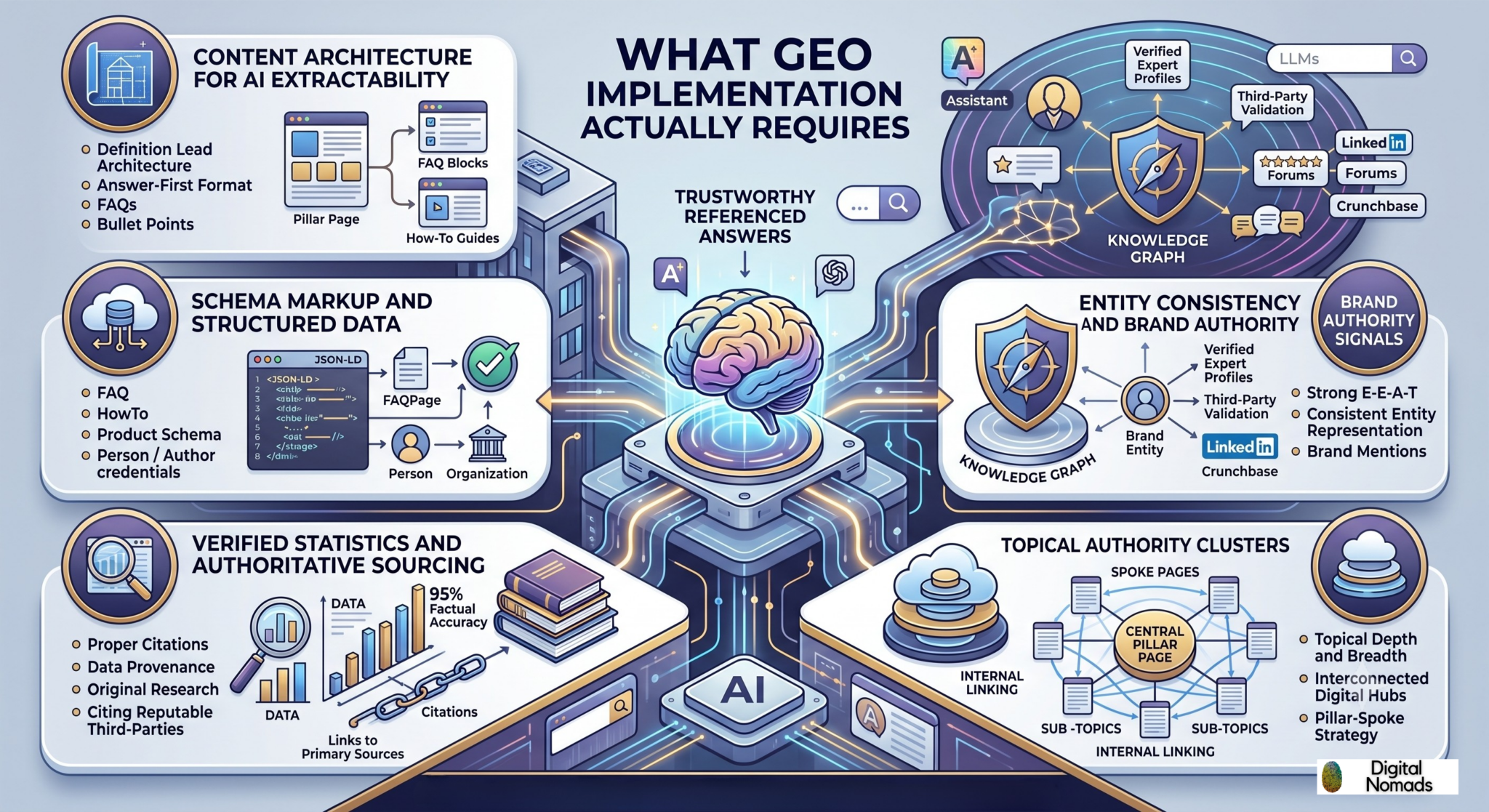
Content architecture for AI extractability
AI systems extract information more reliably from content that directly answers specific questions. This means restructuring existing content around question-based H2 and H3 headings, providing concise direct answers before elaborating, and using structured formats—lists, comparison tables, step-by-step processes—that AI can parse and present cleanly.
Schema markup and structured data
FAQ Schema, HowTo Schema, Article Schema, and LocalBusiness Schema all signal to AI systems how to interpret and categorise your content. Pages built with FAQ schema, clear question headers, and short direct answers get pulled into AI responses far more often than long-form unstructured content. This is technical implementation work requiring genuine SEO infrastructure expertise, not simply content creation.(Source: UD Blockchain)
Entity consistency and brand authority signals
AI systems build understanding of brands through consistent signals across multiple touchpoints—your website, press coverage, third-party reviews, social profiles, and industry directories. Inconsistent brand representation across these sources reduces AI confidence in citing you. Entity clarity—ensuring your brand, services, location, and expertise are represented consistently and verifiably everywhere—is foundational GEO work.
Verified statistics and authoritative sourcing
Research from Princeton University found that optimising for cited sources, verified statistics, and expert quotes can lift visibility in AI answers by 30 to 40%. Content that makes specific, verifiable claims supported by named sources gives AI systems a citable building block. Vague, unsourced content is systematically deprioritised.(Source: UD Blockchain)
Topical authority clusters
A single well-optimised page rarely achieves consistent AI citation. Building topical authority requires a cluster of interconnected content covering a subject comprehensively—signalling to AI systems that your brand is genuinely expert on a topic rather than opportunistically covering it. Our insights library is built on exactly this principle.
Ongoing monitoring and iteration
The AI search market has restructured twice in 24 months—from Google-dominant to ChatGPT-dominant to fragmented. ChatGPT held 89% of AI referrals in August 2025 and 63% eight months later. Claude went from 1.4% to 18.5% in the same window. GEO is not a one-time project. AI models update their knowledge, citation behaviour evolves, and competitors continuously adjust their content. Monitoring AI citation share monthly and iterating accordingly is essential for maintaining visibility. (Source: higoodie)
The GEO Mistake Most Hong Kong Businesses Are Making
The most common GEO error we observe is treating it as a content marketing exercise disconnected from technical SEO and conversion infrastructure.
Businesses publish a handful of FAQ pages, add some Schema markup, and expect citation share to follow. When it doesn’t, they conclude that GEO “doesn’t work for our industry.”
The reality is that AI citation is built on cumulative authority signals—domain credibility, technical accessibility, consistent entity representation, and content depth—that accumulate over time and across the entire digital presence. A few isolated pages cannot compensate for weak technical foundations or inconsistent brand signals.
This is why our approach at Digital Nomads Hong Kong always begins with the same foundation audit we apply to all performance marketing engagements: fixing technical infrastructure, ensuring proper GA4 tracking, establishing content quality baselines, and validating brand entity consistency before layering GEO-specific optimisation on top.
Ready to Build GEO into Your Digital Marketing Strategy?
GEO is not a future consideration for Hong Kong businesses. It is a present competitive reality. The brands building AI citation authority now are establishing positions that will compound in value as AI search adoption continues to accelerate.
But GEO done properly requires genuine technical expertise, strategic content architecture, and ongoing measurement discipline—not surface-level content publication. The businesses gaining AI visibility in Hong Kong’s market are the ones treating GEO as an extension of their existing SEO foundations, not a separate experiment.
Request a free consultation with our team to discuss your current SEO and GEO positioning, identify where your brand stands in AI-generated search results, and explore how a strategically integrated approach can build citation authority across ChatGPT, Google AI Overviews, Perplexity, and beyond.
Or explore our blog for in-depth analysis of Hong Kong’s evolving search landscape and the strategies driving measurable results for local businesses.
Digital Nomads Hong Kong — Lead generation and conversion specialists building AI-ready digital presence for Hong Kong businesses.