
Google Ads Hong Kong: The Complete Guide to Search Advertising and Lead Generation in 2026
Search advertising remains the single highest-intent channel available to Hong Kong businesses — the one most likely to turn a search into an enquiry or a sale. That’s because Google Ads Hong Kong campaigns aren’t competing against other platforms so much as against inattention: in July 2026, Google held 89.31% of all Hong Kong search traffic, according to live data from StatCounter Global Stats, against 3.58% for Bing and 3.39% for Yahoo. In practice, an SEM strategy for Hong Kong is a Google strategy — there is no serious alternative to plan around.
This guide covers what’s actually changed for 2026, what genuinely drives your cost per click, and how search fits into a broader lead generation Hong Kong strategy — not just how to switch campaigns on.
SEM Vs SEO Vs GEO
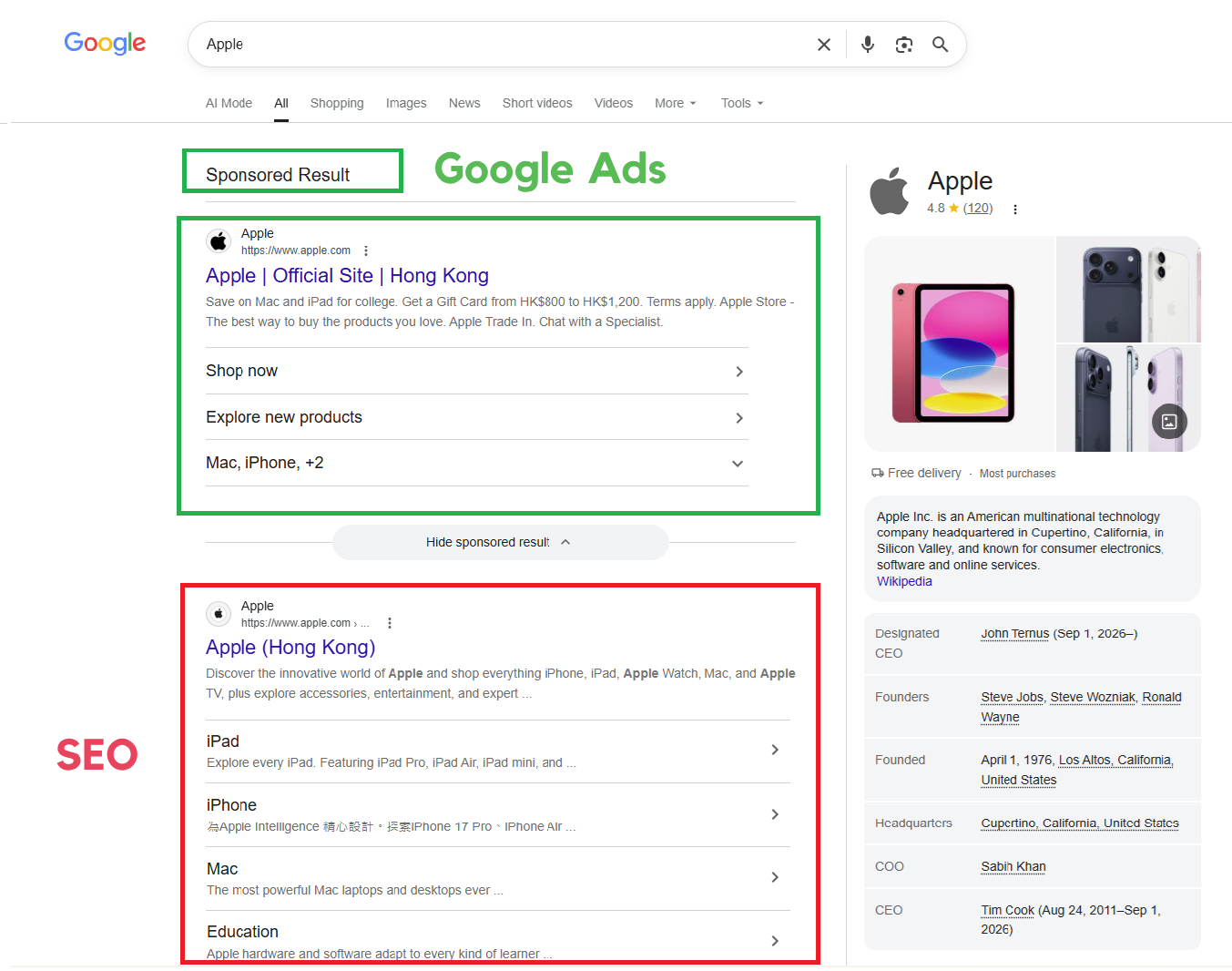
Search Engine Marketing (SEM), Search Engine Optimisation (SEO), and Generative Engine Optimisation (GEO) are often used interchangeably, but they describe three genuinely different disciplines. SEM refers specifically to paid visibility on a search engine’s results page — in practice, this means Google Ads in Hong Kong, where a business pays for every click rather than earning its position. Formerly known as Google AdWords, Google Ads is also frequently called a pay-per-click (PPC) campaign by advertisers.
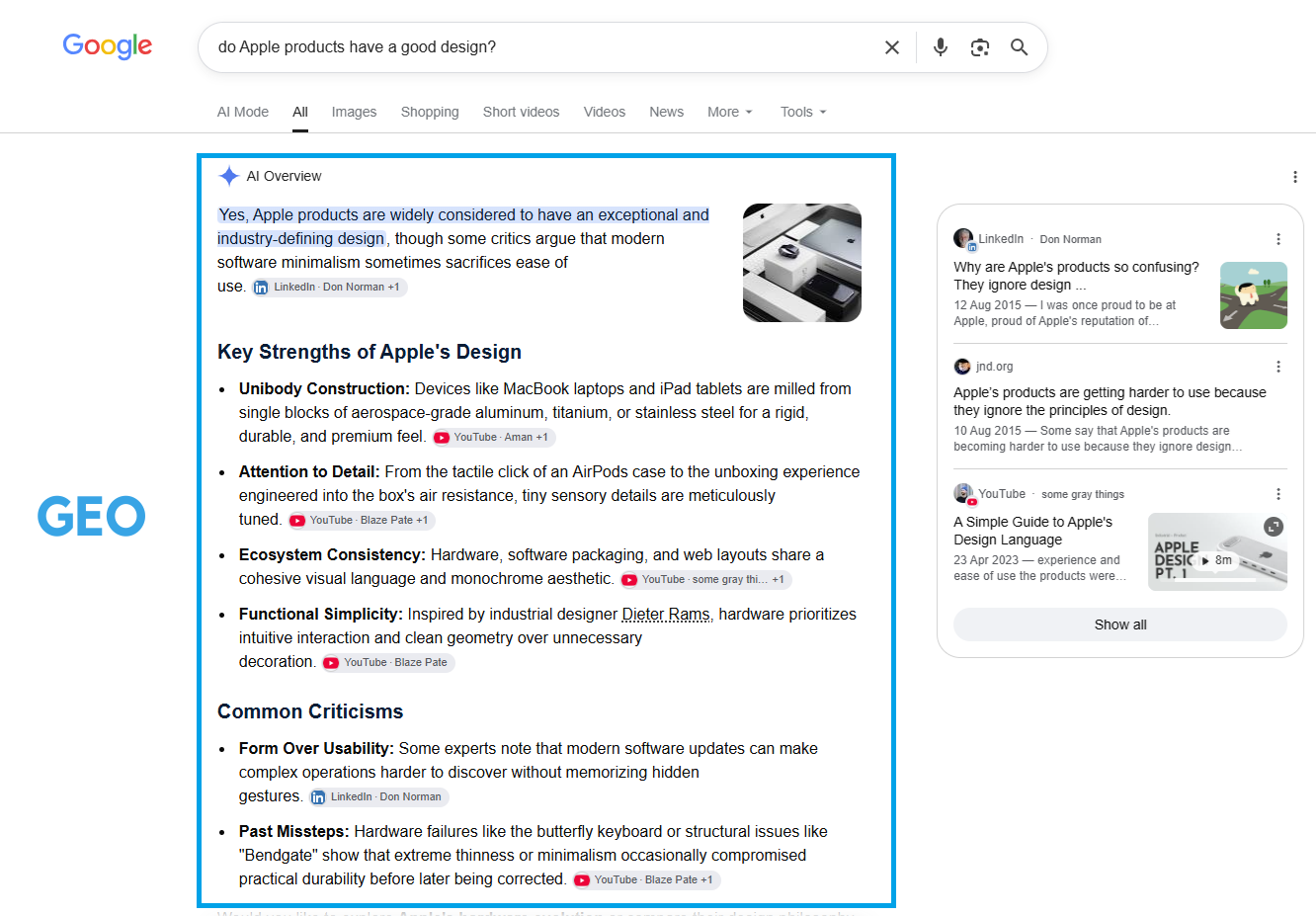
SEO, by contrast, is entirely organic: the ongoing work of technical optimisation, content quality, and authority-building required to rank without paying for each visit, built on the E-E-A-T signals Google has rewarded for years. GEO is the newest of the three, and the most commonly misunderstood: rather than earning a position on a results page, GEO focuses on being cited as a source within AI-generated answers on platforms like ChatGPT, Perplexity, and Google’s own AI Overviews.
Crucially, GEO isn’t a replacement for SEO — it’s built directly on top of it, since AI systems synthesise their answers from sources they already consider authoritative and well-structured, meaning a business with weak SEO fundamentals will struggle to be cited by AI for exactly the same reasons it struggles to rank organically. We’ve written in more depth about why SEM, SEO, and GEO perform best as one integrated strategy rather than three separate budgets, particularly for Hong Kong businesses focused on lead generation.
SEM vs SEO vs Social: Getting the Strategy Straight
Search advertising is “pull” marketing — people search because they already have a need, then click an ad that answers it. That’s fundamentally different from social platforms, which create interest rather than capture it, and from SEO, which earns visibility over months rather than buying it instantly.
None of these are substitutes for each other. SEO and GEO build compounding, trust-based visibility that takes time. Google Ads captures demand the moment it exists. Meta and social campaigns build the awareness that eventually turns into a branded search. Treating any one of these as sufficient on its own — a mistake we see constantly in Hong Kong — leaves real revenue on the table.
The Concept of Search Intent
Search intent is the underlying reason for a user’s query — what they are explicitly looking to achieve when they type a specific phrase into a search engine. It acts as the critical bridge between a consumer’s immediate need and a business’s solution. Understanding this intent is what separates a keyword list from a genuine lead generation strategy.
The distinction between search and social is defined by this intent. Social ads are “push” marketing; they create demand or build brand awareness by interrupting the user experience with relevant content. In contrast, search is “pull” marketing that captures existing, active demand. Consequently, social ads do not possess “search intent” because the user is not actively seeking a solution at that moment — they are being found by the solution instead.
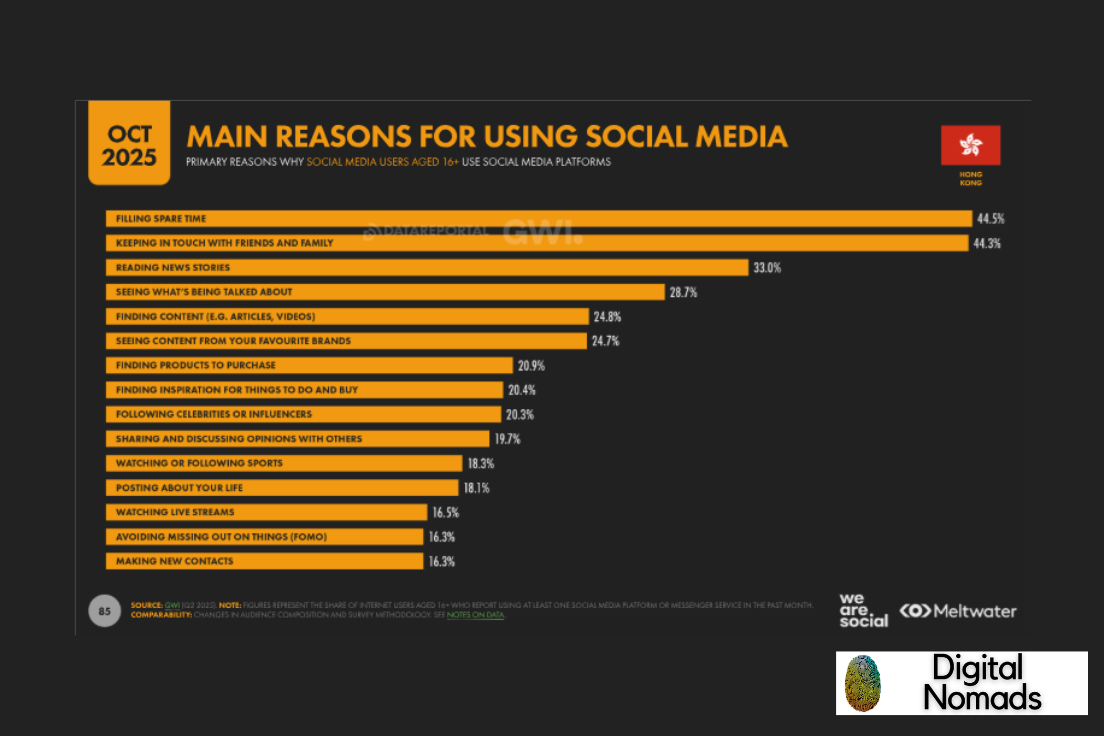
This aspect also emerges from the Digital in HK in 2026 We Are Social and Meltwater report where it’s clearly shown that the main reason for people to use social media is to spend their spare time.
What Actually Drives Your Cost Per Click
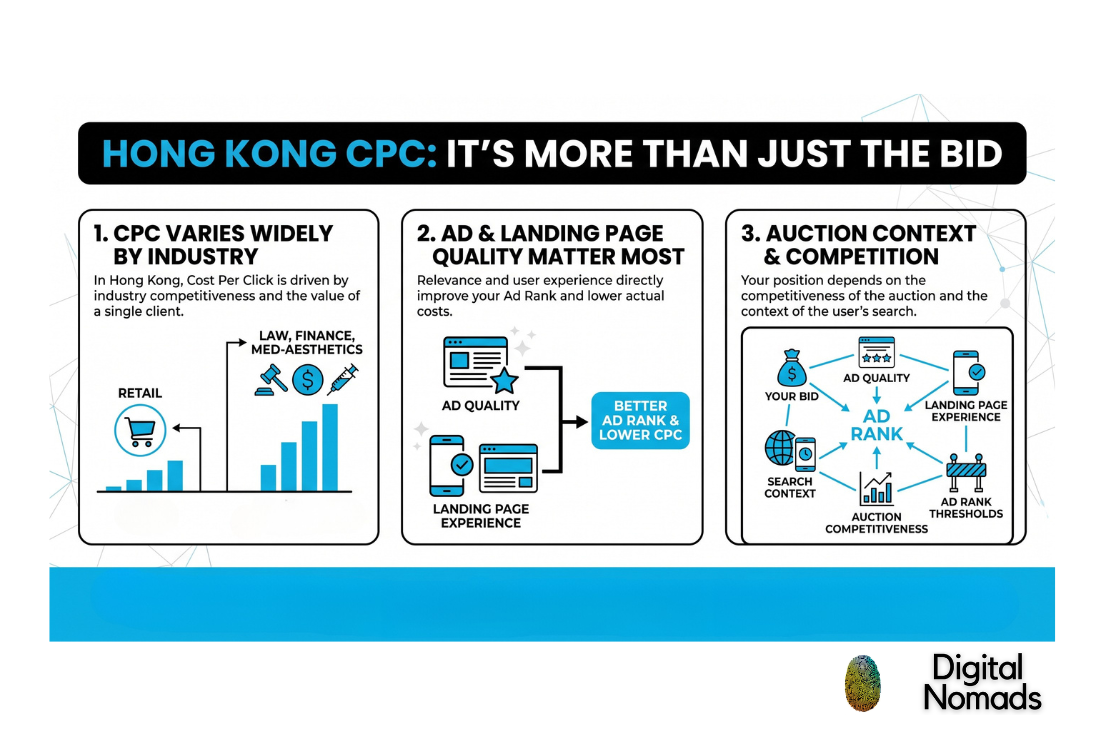
Cost per click in Hong Kong varies enormously by industry — from well under a dollar in some retail categories to upwards in sectors like law, finance, medical aesthetics, and overseas-study education, where the value of a single client justifies aggressive bidding. But the auction isn’t simply “highest bidder wins.” According to Google’s own Ad Rank documentation, your position and actual cost depend on six factors: your bid, the quality of your ads and landing page, Ad Rank thresholds, the competitiveness of the auction, the context of the search itself, and the expected impact of your ad assets (directly linked to your CTR, please see below) .
Assessing Your Cost Per Click
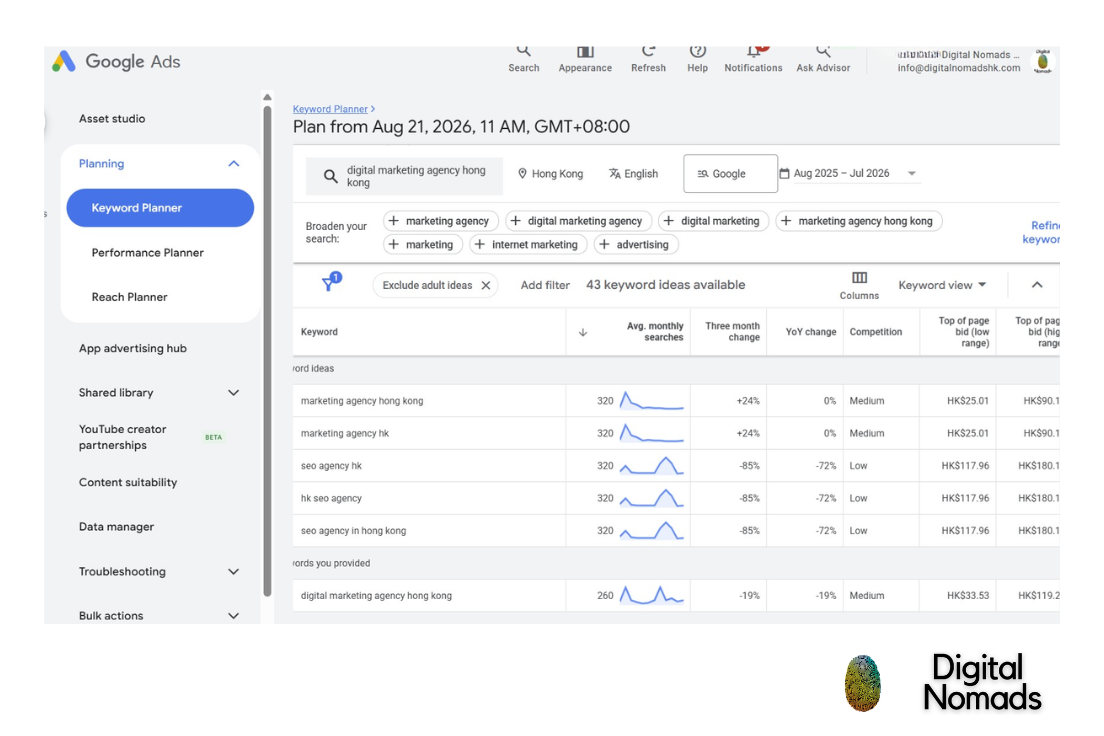
The most effective way to gauge potential costs in your specific industry is to use the Google Keyword Planner. This official Google tool offers valuable estimates regarding keyword competitiveness and cost, allowing you to build more informed budget forecasts.
However, it is important to remember that due to the highly dynamic nature of the keyword auction, it is impossible to set any cost-per-click figure in stone. These metrics are approximations based on historical data and current market trends, not guarantees of future performance.
Quality Score — the 1–10 diagnostic covering expected click-through rate, ad relevance, and landing page experience — is how Google communicates the second of those factors to you. Google states plainly that Quality Score itself is not an input to the auction; it’s a diagnostic tool. But the three underlying signals it measures absolutely do affect your Ad Rank and your real cost per click, which is why we treat landing page relevance as seriously as bidding strategy in every account we manage.
Rather than treating it as a primary Key Performance Indicator (KPI) or a direct input in the real-time ad auction, Quality Score should be interpreted as an aggregated health check of your keyword-to-ad-to-landing-page funnel. By observing this 1-10 score, you can seamlessly pinpoint whether you need to improve ad relevance, boost expected click-through rates, or refine your landing page experience, effectively guiding your optimization efforts to achieve better Ad Rank and lower costs.
The Competitor CPC Myth: Why That ‘Insider Data’ Doesn’t Exist
One of the most persistent myths in Google Ads circles heading into 2026 is the idea that you can know exactly what a competitor is paying per click or how many conversions their campaigns are generating. It’s an appealing idea — a shortcut past your own testing and budgeting — but it’s simply not how the platform works. Google Ads treats advertiser-level cost and conversion data as strictly confidential. There is no dashboard, API endpoint, or backdoor that surfaces another account’s actual CPC, spend, or conversion numbers, and conversions especially leave no trace outside the account that generated them. No agency “insider connection,” no scraping tool, and no premium subscription changes that fact, because the data literally doesn’t exist anywhere outside the advertiser’s own account.
So where does that “competitor CPC” number people cite actually come from? Usually one of two sources, and neither is what it’s marketed as. The first is Google’s own Auction Insights report, a legitimate and useful tool — but it only shows relative metrics like impression share, overlap rate, and outranking share against advertisers you’re already competing against in auctions. It never shows a dollar amount or a conversion figure. The second source is third-party competitive intelligence platforms like SEMrush or SpyFu, which model estimated spend and traffic based on keyword visibility and public signals. These tools are useful for spotting trends and identifying which keywords a competitor seems to be targeting, but their own providers are upfront that the numbers are directional estimates, not verified figures.
The smartest advertisers treat both of these sources for what they are: context, not certainty. Use them to sharpen strategy, not to reverse-engineer someone else’s budget.
Why UX/UI and a Clean Conversion Funnel Matter as Much as the Bid Itself
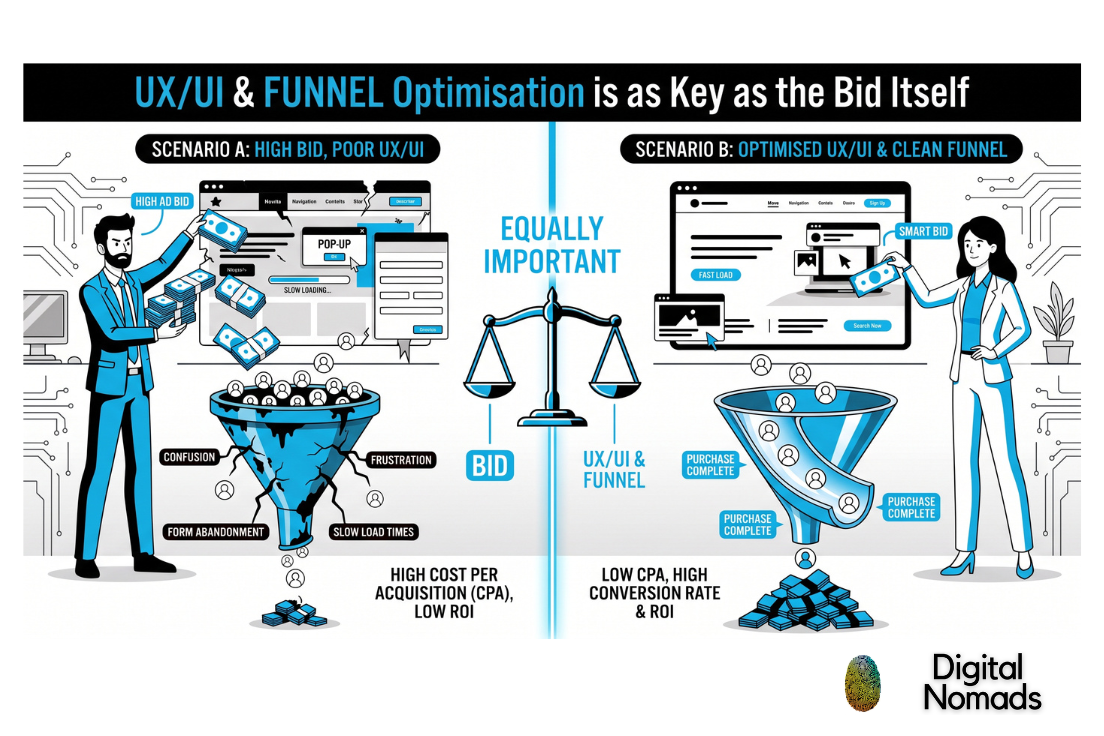
Landing page experience isn’t a soft, subjective factor — it’s one of the three signals that make up your Quality Score, and Quality Score is one of the clearest levers you have over what you actually pay per click. A page that loads slowly, buries its call-to-action, or asks for too much information too soon doesn’t just convert worse; Google measures that friction directly and prices it into your Ad Rank. Fix the landing page, and, all else being equal, your cost per click for the exact same position tends to fall — not because you bid less, but because Google charges you less to win it.
But a cheaper click only solves half the problem. A visitor who lands on a fast, clear, mobile-friendly page and still can’t find checkout, hesitates over an unclear price, or abandons a form asking for six fields when two would do was a wasted click regardless of what you paid for it.
We treat the funnel with the same discipline we apply to bidding strategy, because a beautifully optimised campaign feeding an unoptimised page is, in practical terms, still money left on the table.
Keyword Match Types and the Broad Match Shift
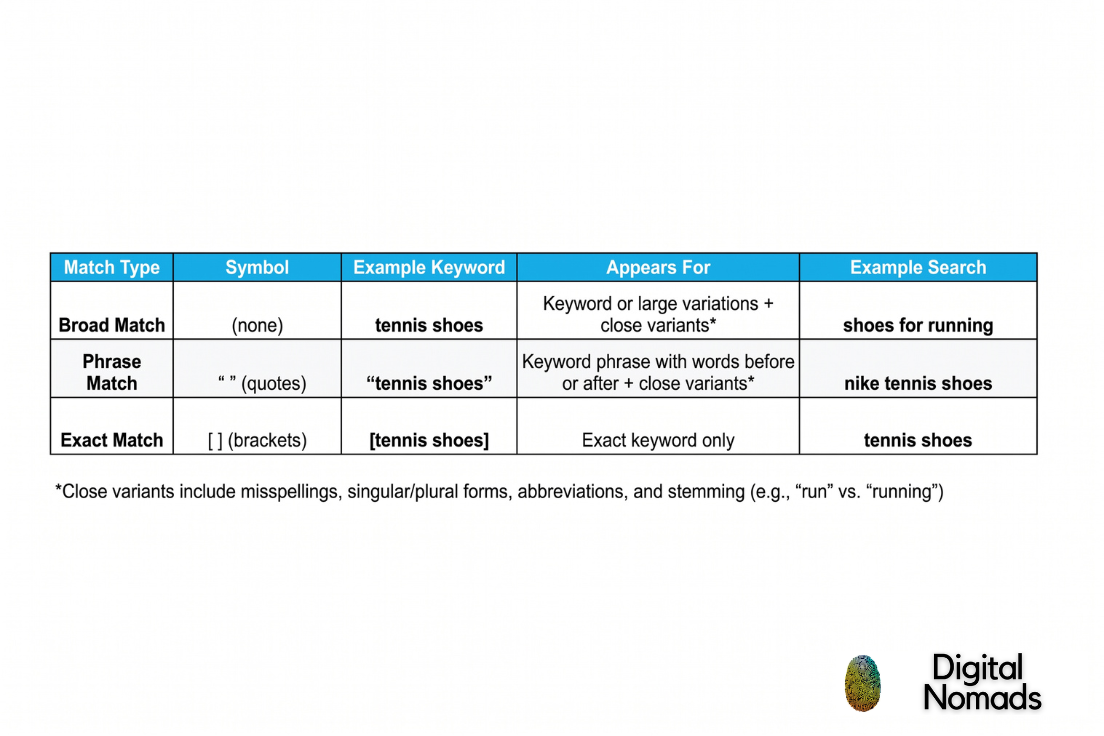
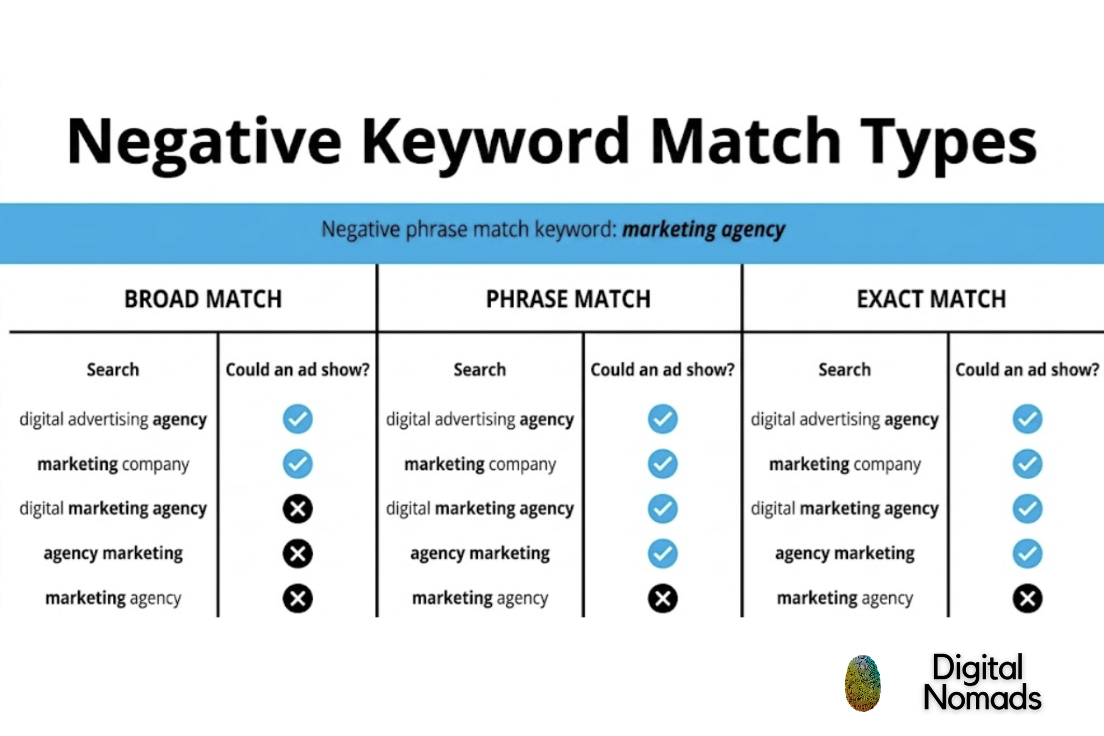
Match types still determine which searches trigger your ad — Exact Match for tight control, Phrase Match for moderate reach, and Broad Match for the widest net. What’s changed meaningfully for 2026 is how safe Broad Match has become. Paired with Smart Bidding and genuinely accurate conversion tracking, Broad Match can now surface converting searches a human keyword list would never have thought to include. The precondition matters enormously, though: feed it inaccurate conversion data and it will optimise confidently towards the wrong outcome.
The Discipline of Negative Keywords
Negative keywords stop your ad appearing on searches you don’t want — but the most common mistake in Hong Kong accounts isn’t too few negatives, it’s too many, applied too bluntly. Before removing a term because it looks irrelevant, check what it has actually converted at over the past twelve months. A search phrase that reads as tangential in a spreadsheet is frequently producing enquiries at a perfectly acceptable cost — Hong Kong’s bilingual, adjacent-vocabulary search behaviour means query wording is a far weaker signal of genuine intent than most advertisers assume. This is a core part of the account audits we run for every new client before touching a single bid.
Our extensive experience working with clients across a diverse range of industries has provided us with deep, practical knowledge regarding the most common negative keywords specific to each vertical. This strategic insight gives us a significant advantage; by preemptively filtering out terms that frequently lead to irrelevant or damaging impressions, we ensure our clients’ budgets are focused solely on high-value traffic from the outset.
Click-Through Rate: The Metric That Feeds Quality Score
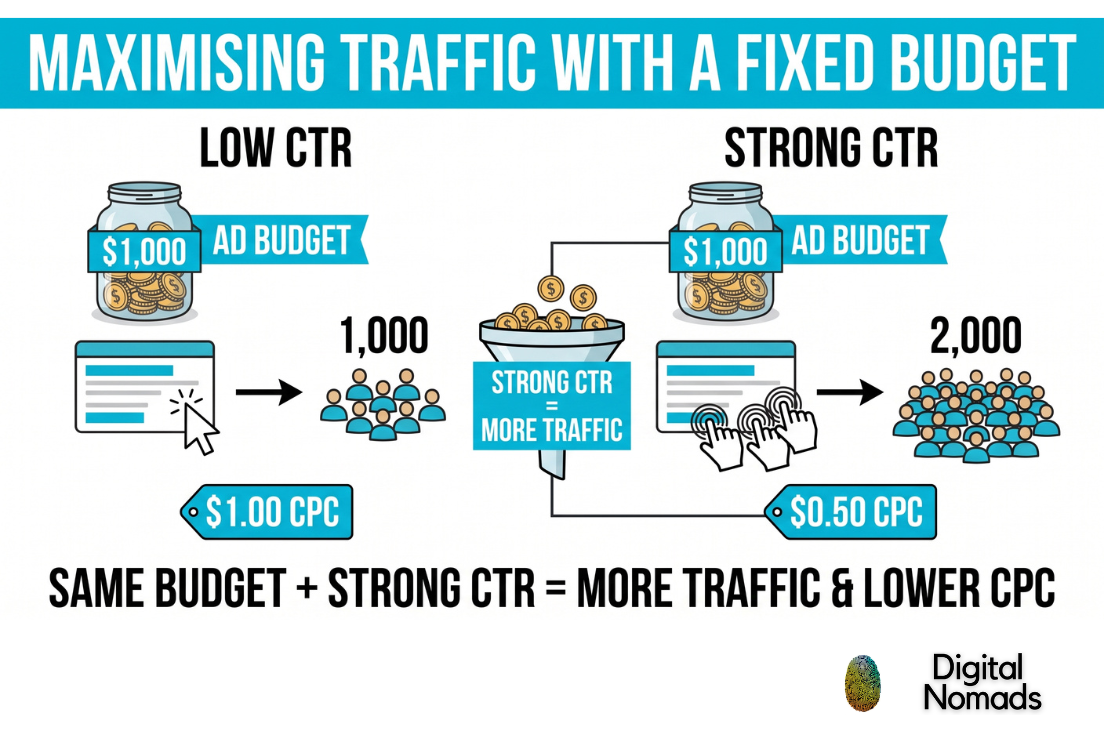
Click-through rate — the percentage of people who see your ad and actually click it, calculated simply as clicks divided by impressions — is one of those metrics that looks like a vanity number but isn’t. It’s the first of the three signals that make up Quality Score, which we covered earlier: a strong CTR tells Google your ad is genuinely relevant to the search that triggered it, and Google rewards that relevance directly, in the form of a better Quality Score, a better Ad Rank, and, as already established, a lower real cost per click for the exact same position.
From what we’ve seen across the search campaigns we manage, a good CTR starts from 8% and above. Below that threshold, there’s usually room to improve — sometimes in ad copy relevance, more often in how tightly an ad group is themed around a single search intent rather than several loosely related keywords sharing one generic ad.
CTR isn’t something we report at the end of the month and move on from. It’s one of the earliest, clearest signals of whether an account is fundamentally healthy, and it’s typically the first number we look at when auditing a new client’s existing campaigns.
A higher CTR consistently leads to a lower cost per click. The stronger your click-through rate, the more traffic you can drive from the exact same ad budget.
What’s Genuinely New in 2026
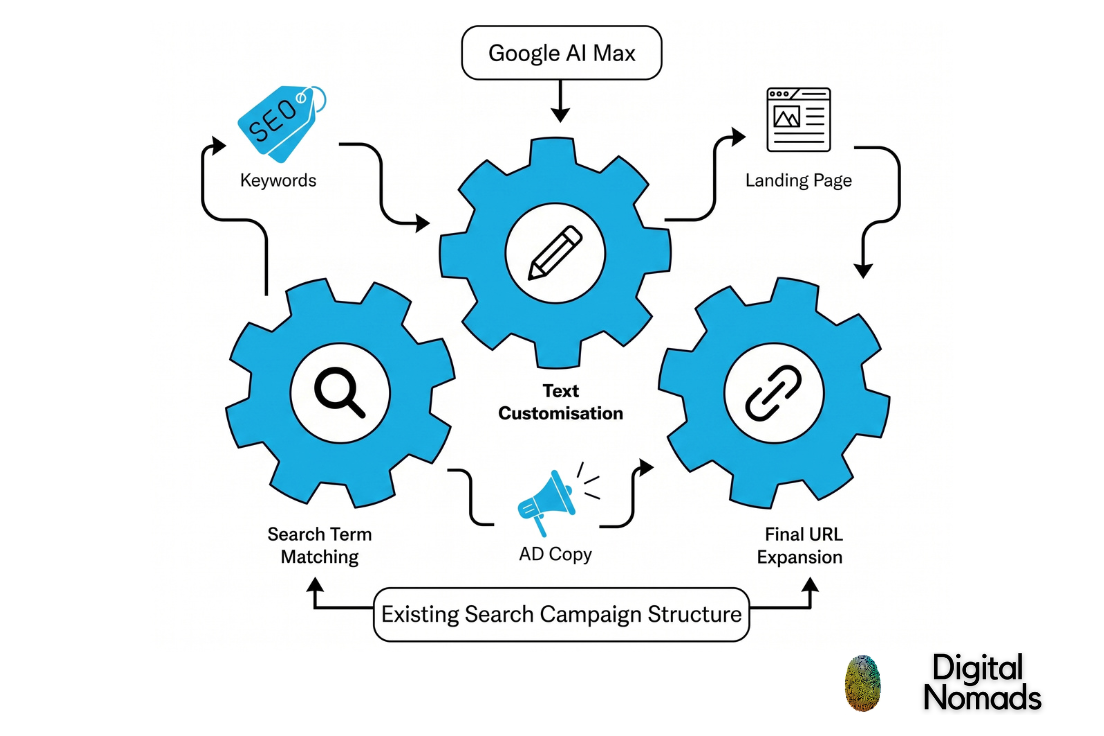
AI Max for Search continues to be one of the more consequential additions to the platform. According to Google’s own data, advertisers activating AI Max see an average 14% increase in conversions at a similar cost, rising to as much as 27% for accounts still running primarily exact and phrase match. It works by expanding keyword and creative matching using your existing assets and landing pages — which is exactly why we only activate it once an account has clean, sufficient conversion data, rather than switching it on for every new campaign by default.
We’ve tested this directly across our own client accounts, activating AI Max roughly three months after each campaign’s initial launch — once enough conversion history had built up for the system to learn from real and meaningful conversions rather than guesswork. Once that threshold was met, the results for a clinic that has to generate leads for their specialists were genuinely significant: click-through rate rose by an additional 1.2%, and conversions generated, measured month-over-month, effectively doubled.
That uplift comes with two conditions we treat as essential, not optional. First, AI Max learns from whichever conversions you feed it, so choosing the right conversion actions to optimise towards — genuine leads and sales, not every minor on-site interaction — has to be settled before activation, not adjusted afterwards. Second, because AI Max expands matching beyond your existing keyword list, monitoring the Search Terms Report to catch and add new negative keywords stops being routine housekeeping and becomes non-negotiable on every account where it’s switched on.
Smart Bidding Exploration, introduced in 2025, has quietly become one of the most useful additions for accounts stuck bidding on the same obvious terms as every competitor. It’s a feature that lets the algorithm test search queries outside your normal, proven keyword list — essentially giving it permission to try new, less obvious searches to find customers a tighter keyword strategy would miss. Google’s own reporting shows early adopters seeing an 18% increase in unique converting search categories and a 19% increase in total conversions.
Performance Max received a genuinely substantial round of updates this year — channel-level placement reporting (finally showing exactly where your ads served across Search, Shopping, Display, YouTube, Discover, Gmail, and Maps), first-party audience exclusions, campaign-level negative keywords, and expanded creative testing. We’ve covered this in full on our dedicated Performance Max page.
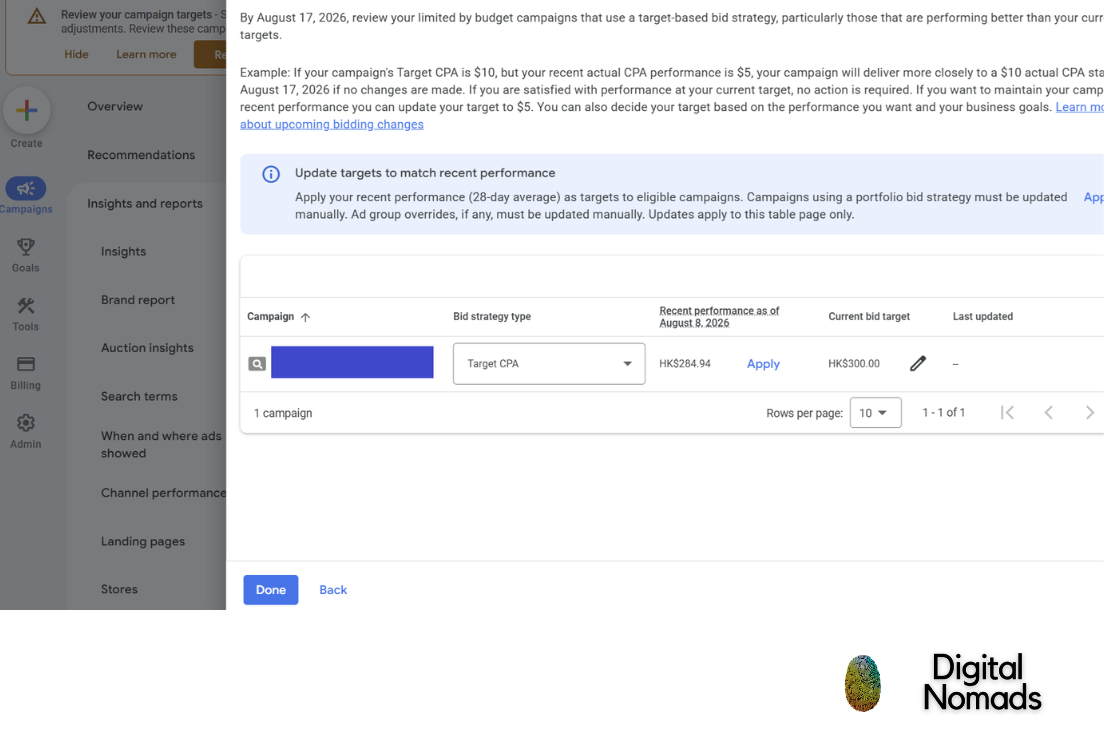
Perhaps most significant of all, and taking effect from 17 August 2026, Google is changing how budget-limited campaigns using Target CPA, Target ROAS, or Target CPC (for Demand Gen) behave, according to Google’s own Help Centre announcement. Previously, a campaign constrained by budget could quietly outperform its stated target indefinitely — a Target CPA set at HK$80 might have been consistently delivering at HK$40 for months, and nobody would necessarily notice. From now on Smart Bidding will optimise campaigns to track far more closely to the actual figure you’ve set, even as budgets change. If your accounts have been running comfortably under target for a while, this is genuinely worth reviewing now rather than after performance shifts unexpectedly — Google has made a Bid Target Adjustment Tool available in-platform since 6 July specifically for this review.
After this change, we evaluated each campaign’s actual performance against its targets. If a campaign has been outperforming its set target, we decide whether to adjust the target to reflect this reality or maintain the original goal. We only reallocate budgets when justified by data, and we allow enough time for changes to stabilize before assessing results.
The WhatsApp Asset Most Advertisers Still Aren’t Using
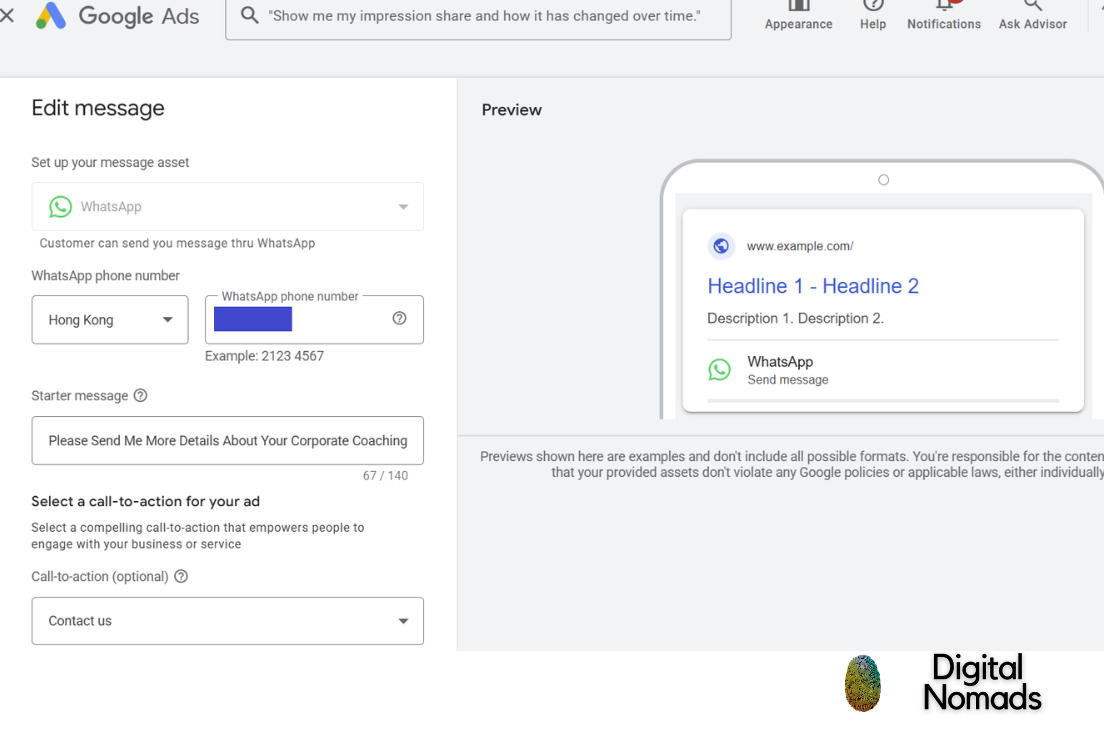
Introduced quietly in late 2025, the WhatsApp asset for Google Ads lets a search ad open directly into a WhatsApp conversation, rather than routing a prospect through a landing page form. It arrived without big announcements as for AI Max or Performance Max, and adoption across the Hong Kong accounts we audit remains genuinely low — most advertisers simply aren’t using it, largely because they’ve never heard of it.
That gap is a real missed opportunity given how this city actually communicates. As we’ve covered in detail in our guide to building a Google Ads and WhatsApp funnel, 71% of Hong Kong consumers message businesses at least once a week, and 62% of local online purchases are completed on mobile. For a market with messaging habits like these, sending a high-intent searcher straight into a chat window they already check daily converts far more reliably than asking them to complete a form they may never finish. It’s a small setting buried in campaign asset options, but for any advertiser serious about lead generation Hong Kong businesses actually respond to, it’s one of the more consequential features currently sitting underused.
The future: Google Ads and AI Overviews
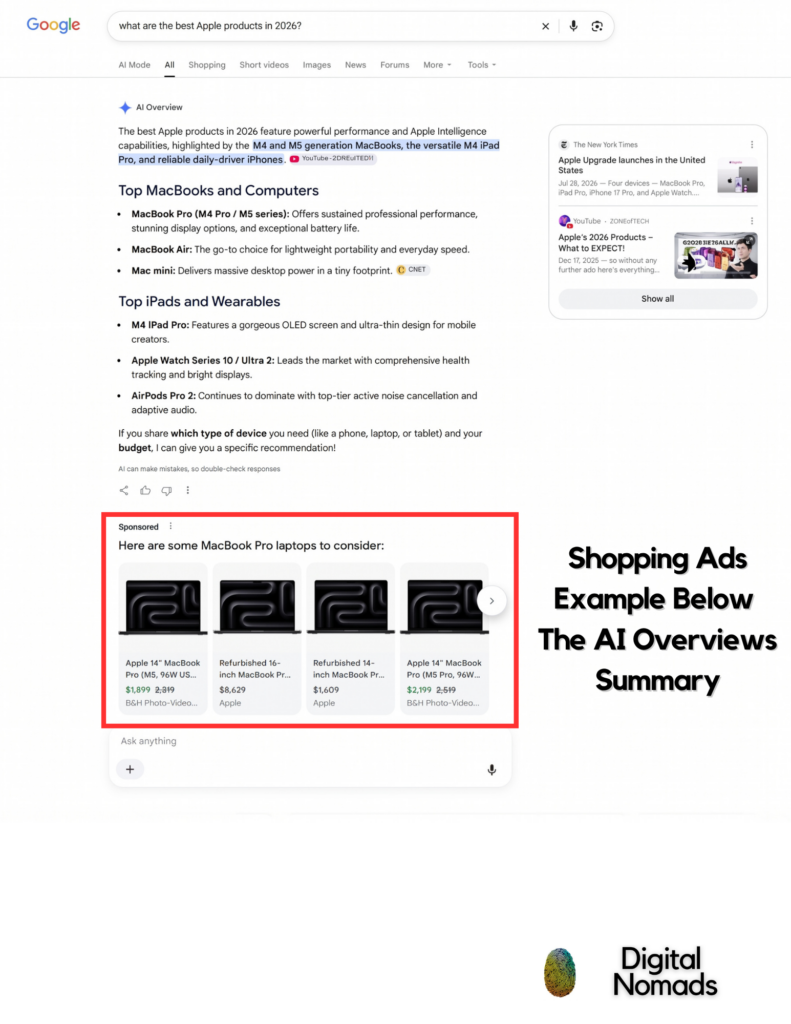
For the past two years, AI Overviews sat above traditional search results as a summary, with ads still running separately alongside them. That separation is closing fast. AI Overviews now appear on more than 48% of Google searches, up from just 6.49% a year earlier, according to independently tracked data. At Google Marketing Live in May 2026, Google confirmed the next stage: ads placed directly inside AI-generated responses, not merely positioned around them.
According to official Google Ads Help documentation, existing text, shopping, local, or app ads from your Search, Shopping, Performance Max, and App campaigns are now automatically eligible to display above, below, or directly within AI-generated summaries.
The new formats move well beyond a static ad slot. Rather than matching a query to a fixed headline, Google’s newer conversational ad formats respond to the specific framing of a search — the actual context and intent behind it, not just the keywords used. A “Direct Offers” format now lets businesses with genuine commercial intent surface a specific, relevant offer within the AI’s own answer, whilst a shared “Universal Cart” lets a purchase started on one Google surface continue seamlessly on another. Google’s own research found 75% of shoppers say AI Mode helps them make faster, more confident purchasing decisions — the commercial logic behind pushing ads deeper into these surfaces.
Furthermore, AI-powered search is accelerating a “zero-click” trend where users get answers faster, requiring advertisers to align their ads with informational intent earlier in the decision journey.
While this functionality is presently restricted to specific territories—including Australia, Canada, India, Indonesia, Kenya, Malaysia, New Zealand, Nigeria, Pakistan, Philippines, Singapore, and the US—where it serves English-speaking users on both mobile and desktop, it is expected to fundamentally affect the search landscape in Hong Kong in the very near future.
Search Doesn’t Win Alone
None of the above matters much if it’s disconnected from everything else your business does online. We’ve written previously about why integrating SEO, GEO, and Google Ads outperforms running them separately — appearing in both paid and organic results for the same query can lift combined click-through rate by up to 40%, and a properly structured Google Ads Hong Kong presence increasingly matters more, not less, as AI Overviews compress organic clicks on informational searches. The businesses winning right now aren’t choosing between channels. They’re running them as one connected system.
Bonus: Turning Search Intent Into a YouTube Advantage
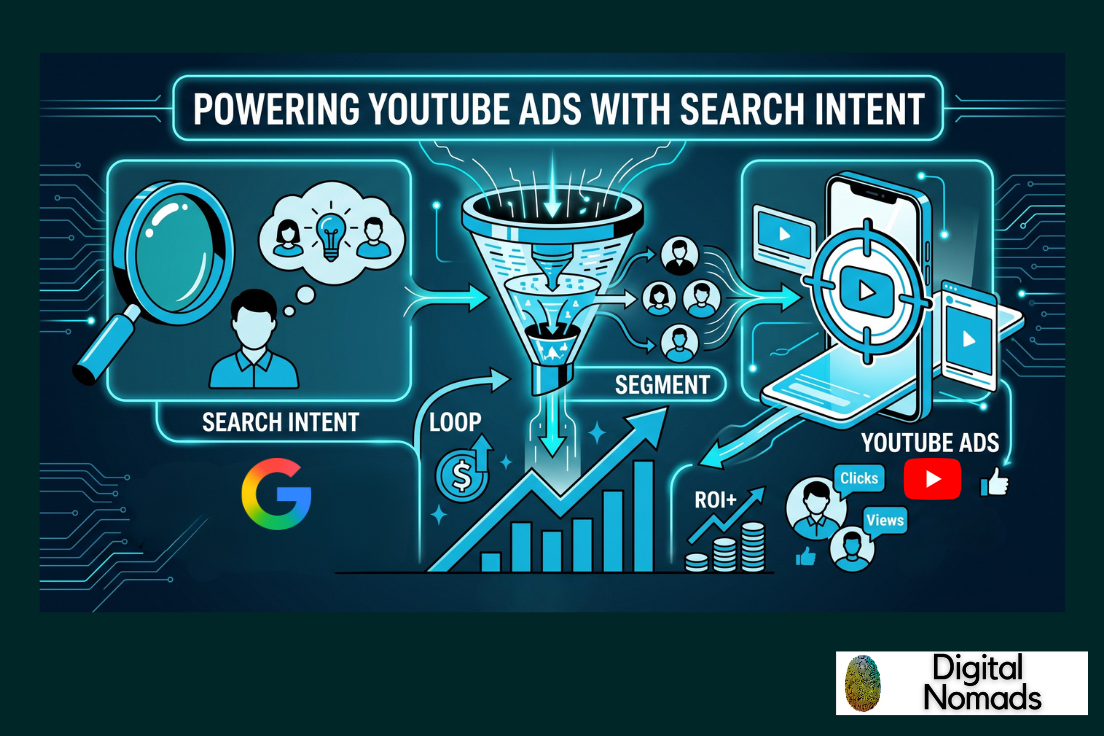
One of the more effective, still underused tactics we run is deliberately connecting Search and Demand Gen, rather than treating them as separate campaigns competing for the same budget. This matters even more in Hong Kong specifically: YouTube is the city’s second most visited website overall, trailing only Google itself, according to We Are Social and Meltwater’s Digital 2026 Hong Kong report — meaning the audience you’re already reaching through Search is, in nearly every case, also watching YouTube regularly.
Google Ads lets you build a Custom Segment from the actual search terms people have typed into Google — pulled directly from your own Search Terms Report — and apply that list as an audience within a Demand Gen campaign. Crucially, this only preserves genuine search intent when the campaign stays within Google’s own inventory (YouTube, Discover, Gmail, and Maps, with Display network and video partners switched off); apply the same segment to a standard Display campaign, and Google can no longer reliably identify who actually searched those terms, so it quietly downgrades the signal to a broader “interest” category instead.
Used properly, this means a prospect who searched “corporate gift hampers Hong Kong” this morning can see your YouTube ad this afternoon — not as a stranger meeting your brand for the first time, but as the exact same high-intent searcher, reinforced on a second, more visual format, without paying for a second click on Search. Across the e-commerce brands in our own portfolio, running Search and Demand Gen in parallel this way has produced a 25% increase in conversions month over month, compared to running either channel in isolation.
It’s one of the clearest examples of why we don’t run Google Search Ads and YouTube Demand Gen as separate line items — run as one connected system, each channel makes the other meaningfully more efficient.
Real Results From Hong Kong Accounts
A Hong Kong education provider saw a 32% increase in qualified leads at an 18% lower cost per acquisition after we rebuilt their account from Quality Score fundamentals upward, rather than layering AI features onto broken tracking.
PetCubes, a Hong Kong retailer of human-grade, AAFCO-certified dog food, saw a 60% increase in total orders over six months after we built Google Ads, Performance Max, and YouTube Demand Gen campaigns to run as one connected acquisition engine rather than separate line items. Cost per acquisition came in 35% lower than their existing social media campaigns over the same period, whilst overall ROAS rose by 98%.
The Real Cost of Google Ads in Hong Kong: Ad Spend vs Agency Fees
The total cost of running Google Ads in Hong Kong is really two separate numbers, and it’s worth understanding both before signing with any provider. The first is the advertising spend itself — the cost per click paid directly to Google, driven by competition, Quality Score, and Ad Rank, as covered earlier. The second is the agency fee for managing that spend, and this is where structures vary considerably. Many agencies charge a percentage of monthly advertising fees, commonly around 20%, and typically ask clients to commit to a fairly large, consistent monthly budget to make that model work in the agency’s favour.
We don’t operate that way. Digital Nomads Hong Kong charges a fixed monthly fee, and we don’t ask clients to commit to a large budget from day one. Frankly, that’s the easier problem to solve — almost any reasonably built campaign performs once you throw enough budget at it. The genuinely difficult part, and the part that actually matters to a business watching its cash flow, is making a campaign perform on limited resources first, then scaling the budget once the data proves it’s working. That’s exactly why we run every account on a test-and-scale approach: we grow what’s already proven to work, and stay disciplined about cutting the unwanted clicks that quietly drain a budget before a campaign has had the chance to prove itself.
DIY, or Work With an Agency?
With a small budget, a simple product, and time to learn the platform, running Google Ads yourself is entirely realistic. The calculation changes once spend reaches meaningful scale, your vertical is genuinely competitive, or the hours you’re spending in the interface are hours not spent running your business.
When evaluating a digital marketing agency that Hong Kong businesses can actually trust with a real budget, the questions you ask need to be highly specific: Are they a certified Google Partner? Do their reports explain what changed and why, rather than just dumping a wall of impressions? Do senior experts stay hands-on, or is your account handed off to whoever is free?
We cover this in more depth in our guide on what differentiates top-performing digital marketing agencies. Ultimately, the same logic applies whether you are looking for a general online marketing agency in Hong Kong or searching specifically for Google Ads specialists. The underlying evaluation criteria never change: you need verifiable results, transparent pricing, and deep platform expertise, rather than a generic agency delivering mediocre work across fifteen different services.
Ready to Put This Into Practice?
As a certified Google Partner, Digital Nomads Hong Kong builds Google Ads as part of one connected lead generation system alongside SEO, GEO, and social — not a channel run in isolation.
Request a free consultation to review your current account, including whether today’s Target CPA and ROAS changes affect any of your existing campaigns.
Frequently Asked Questions.
What is SEM, and is it the same as Google Ads?
SEM (Search Engine Marketing) is the umbrella term for paying to appear on a search engine’s results page. Google Ads is the specific platform almost every Hong Kong business means when they say SEM, since Google holds over 89% of local search traffic. PPC (pay-per-click) describes how you’re charged, not the strategy itself — SEM is the concept, Google Ads is the tool, and PPC is the billing model.
How much does Google Ads cost in Hong Kong?
There’s no flat rate — cost per click depends entirely on how competitive your industry is, ranging from under a dollar in some retail categories to much more in sectors like law, finance, and medical aesthetics. Most Hong Kong SMEs need enough working budget to gather meaningful conversion data before judging true return on ad spend, rather than expecting final ROAS within the first few weeks. If you are looking for specific estimates, the Google Keyword Planner is an excellent official resource to identify cost per click for keywords in your vertical with good precision. However, remember that due to the dynamic nature of the keyword auction, it is impossible to set any cost-per-click figure in stone; these metrics are approximations, not guarantees of future performance.
Does Quality Score directly affect my cost per click?
Not directly — Google states plainly that Quality Score itself isn’t an input in the ad auction, it’s a diagnostic tool. However, the three signals it measures (expected click-through rate, ad relevance, and landing page experience) absolutely do feed into Ad Rank, which does determine your actual cost per click.
Can I find out exactly what CPC or how many conversions my competitor is getting?
No — and be careful for anyone who claims otherwise. Google Ads never exposes another advertiser’s actual CPC or conversion data; conversions in particular leave no external trace at all, so no tool, agency, or “insider access” can genuinely produce that number. What you can get is two different things, and it matters not to confuse them: Google’s own Auction Insights report, which shows real but relative signals like impression share, overlap rate, and outranking share against advertisers you’re actively competing with — never a dollar figure or a conversion count. Separately, third-party tools like SEMrush or SpyFu offer estimated spend and traffic based on modelled keyword visibility, which their own providers openly describe as directionally useful rather than accurate. Treat both as competitive context, not as a report of what your competitor is actually paying or converting.
Is Broad Match safe to use in 2026?
Yes, provided it’s paired with Smart Bidding and genuinely accurate conversion tracking. Broad Match in 2026 can surface converting searches a manual keyword list would never capture, but it depends entirely on the quality of the data it’s learning from. Additionally, if you incorporate broad match keywords into your campaign, it is advisable to review the search terms report with greater frequency to discover and exclude irrelevant matched terms as negative keywords.
What is AI Max for Search, and when should I switch it on?
AI Max is Google’s AI-driven expansion of keyword and creative matching, built on your existing assets and landing pages. We typically activate it around three months after a campaign launches, once enough conversion history exists, the right conversion actions are clearly defined, and the Search Terms Report is being actively monitored for new negative keywords.
What's changing with Target CPA and Target ROAS bidding on 17 August 2026?
From that date, campaigns limited by budget will track far more closely to the actual Target CPA or Target ROAS set, rather than being able to quietly outperform it indefinitely. If your campaigns have been running comfortably under target for a while, this is worth reviewing now, before performance shifts unexpectedly.
Do I still need SEO if I'm already running search ads?
Yes — the two aren’t substitutes. Appearing in both paid and organic results for the same query can lift combined click-through rate by up to 40%, and as AI Overviews compress organic clicks on informational searches, an integrated approach across SEO, GEO, and paid search consistently outperforms running any one channel alone.
Can I manage this myself, or is an agency worth it?
With a small budget, a simple product, and time to learn the interface, managing your own account is realistic. The calculation shifts once spend reaches real scale, competition intensifies, or the hours spent in the interface would be better spent running the business.
How long before a Google Ads account starts producing results?
Ads can generate clicks and impressions immediately, but gathering enough conversion data for Smart Bidding to learn and stabilise generally takes several weeks. Judging true performance — including whether AI Max or Performance Max are worth activating — is usually more realistic after two to three months of consistent data collection.