
Google Ad Grants Audio Summary
Most Hong Kong charities are leaving free advertising money on the table without realising it exists. Google Ad Grants gives eligible nonprofits up to US$10,000 per month in Google Search advertising, entirely free. In Hong Kong, the qualifying criteria is straightforward: your organisation must be registered as a charitable institution exempt from tax under Section 88 of the Inland Revenue Ordinance.
The catch is that “free” doesn’t mean “unmanaged.” Ad Grants comes with some of the strictest compliance rules in the entire Google Ads ecosystem, and most charities either never apply, or apply and lose the grant within months. Below is how the programme actually works, what changed for 2026, and how we’ve used it to genuinely move the needle for The Nature Conservancy Hong Kong.

How Google Ad Grants Actually Works
Eligibility verification runs through Goodstack, which replaced TechSoup as Google’s verification partner in 2026. Once approved through Google for Nonprofits, your organisation gains access to a Google Ads account funded at up to US$10,000 monthly — paid per click, only when someone actually clicks your ad, exactly like a standard commercial account.
That’s where the similarity to a standard account ends. Ad Grants only funds Search campaigns by design (the exception being the 2026 Performance Max update, covered below), meaning the entire budget goes towards capturing people actively searching for the causes your organisation supports.
The Compliance Rules That Actually Determine Success
This is the part most nonprofits underestimate, and it’s precisely where genuine Google Ads expertise stops being optional.
The 5% click-through rate rule. Your account must maintain a minimum 5% CTR at the account level every month. Fall short for two consecutive months, and Google can deactivate the account. New accounts get a 90-day grace period — but that’s not long if your keyword structure isn’t right from the outset.
Keyword restrictions. Single-word and overly generic keywords are banned outright, and any keyword scoring a Quality Score of 1 or 2 must be paused or removed. This means Ad Grants campaigns demand tighter, more deliberate keyword grouping than most commercial accounts ever require.
Structural minimums. Each campaign needs at least two active ad groups, each containing at least one responsive search ad, alongside properly configured geo-targeting and working conversion tracking, with a minimum of one tracked conversion monthly.
Landing page discipline. Ads must point to specific, relevant pages — not simply the homepage — and Google increasingly evaluates whether the landing page genuinely matches what the ad promised.
Smart Bidding is now mandatory. As of 2026, manual CPC bidding is no longer permitted on Ad Grants accounts. Every campaign must run on a Smart Bidding strategy, typically Maximize Clicks or Maximize Conversions. The advantages are substantial: this removes the old US$2 maximum-bid cap that used to shut Ad Grants accounts out of competitive keywords entirely, provided the account has enough conversion volume — generally 15 to 30 monthly — for the algorithm to learn from.

What’s Genuinely New for 2026: Performance Max Arrives
The most significant structural change to the programme this year is that Performance Max campaigns are now permitted on Ad Grants accounts — a meaningful shift from a programme that had been Search-only for its entire history. Even more useful: Performance Max campaigns are exempt from the account-wide 5% CTR requirement, since they don’t behave like traditional Search campaigns.
For nonprofits with a compelling visual story to tell this genuinely opens up new territory that simply didn’t exist within the programme before this year.
Case Study: The Nature Conservancy Hong Kong
We’ve written previously about how our Demand Gen and YouTube advertising work for The Nature Conservancy generated close to 930,000 views in six months, using creative built around Google’s ABCD framework. This time, the focus is different: what we’ve achieved specifically through their Google Ad Grants search account.
When we took over TNC’s Ad Grants account, our first priority wasn’t spending the full US$10,000 immediately — doing so carelessly is exactly how accounts fail the CTR and Quality Score rules within days. Instead, we built campaign structure and keyword groupings deliberately, ramping utilisation up over three months until the account reached 100% of the available US$10,000 monthly grant, fully compliant, with account-wide CTR comfortably clear of the 5% threshold throughout.
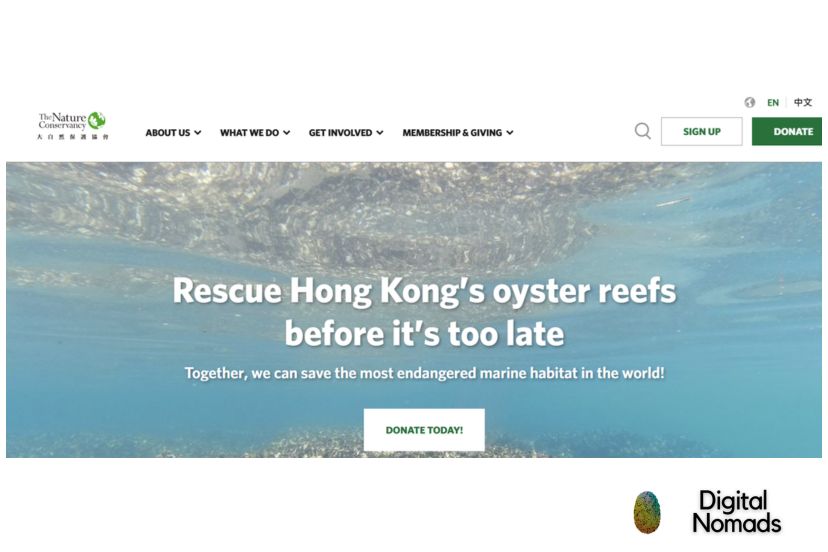
That disciplined ramp-up paid off in the metric that actually matters to a conservation charity: donations attributed to the search campaigns grew by 20% month-over-month, a sustained growth curve rather than a single spike, driven by consistently refining keyword targeting and landing page alignment against TNC’s specific conservation projects — Hong Kong’s oyster reef restoration among them.
Why This Requires Genuine Expertise, Not Just an Application
Getting approved for Google Ad Grants is the easy part. Structuring an account that reaches full budget utilisation while staying compliant with rules stricter than most commercial advertisers ever encounter is where charities most often struggle — and where our approach, built around continuous optimisation, Quality Score discipline and genuine conversion tracking, applies directly.
As a certified Google Partner, we bring the same fundamentals-first methodology to nonprofit accounts as we do to commercial ones — because Ad Grants, if anything, punishes shortcuts more severely than a paid account ever would.

Is Your Hong Kong Nonprofit Eligible?
If your organisation holds Section 88 charitable status and isn’t currently using Google Ad Grants, there’s a genuine, measurable opportunity sitting unused. Request a free consultation to discuss your eligibility and what a properly structured account could achieve for your cause.
Frequently Asked Questions.
Is my Hong Kong charity eligible for Google Ad Grants?
Yes, provided your organisation is registered as a charitable institution exempt from tax under Section 88 of the Inland Revenue Ordinance. Eligibility verification is handled through Goodstack, which replaced TechSoup as Google’s verification partner in 2026, via the Google for Nonprofits programme.
How much is Google Ad Grants actually worth?
Up to US$10,000 per month in free Google Search advertising, paid only when someone clicks your ad, exactly like a standard paid account. It’s an in-kind grant rather than cash, so it can only be spent within Google Ads itself, not withdrawn or redirected elsewhere.
Why do Google Ad Grants accounts get suspended?
Most commonly, an account-wide click-through rate falling below 5% for two consecutive months, or active keywords with a Quality Score of 1 or 2 that haven’t been paused. Broken conversion tracking and generic or single-word keywords are the other frequent causes — all of which are avoidable with regular account monitoring rather than a one-off setup.
Can Google Ad Grants fund Shopping, Display, or video ads?
Historically, no. The programme has always been Search-only by design. That changed in 2026: Performance Max campaigns are now permitted on Ad Grants accounts, and are exempt from the account-wide 5% CTR rule since they don’t behave like standard Search campaigns.
Do I need an agency to manage a Google Ad Grants account?
Not strictly, but the compliance bar is genuinely higher than most nonprofits expect — mandatory Smart Bidding, strict keyword quality thresholds, and landing page requirements that go beyond what a typical volunteer-run account can maintain month after month. Charities managing this well-in-house tend to have someone dedicating real, ongoing time to it, rather than treating it as a one-time setup.