
AI-driven search campaigns only turn into revenue when four things line up: the conversions you feed Google’s AI, a landing page built for one action, a lead-capture route that suits the buyer, and sales outcomes sent back into Google Ads. When these four pillars work in harmony, AI search marketing in Hong Kong transitions from wasting budget on clicks to acquiring real clients.
In Hong Kong’s highly competitive commercial landscape, effective lead generation relies heavily on capturing with precision this high-intent search demand and converting it efficiently before prospects turn to local competitors.
That matters here more than in most markets. As outlined in our previous overview of 2026 Google Ads updates, Google accounts for the vast majority of search volume in Hong Kong, making AI search marketing largely synonymous with leveraging Broad Match, Smart Bidding, AI Max, and AI Overviews within a single ecosystem. Plenty of advertisers switch these features on, watch traffic climb, then discover that the budget is feeding unqualified enquiries and leaky pages. This article is the sequel to our Google Ads guide and our SEO and GEO analysis. It covers what happens after the click.
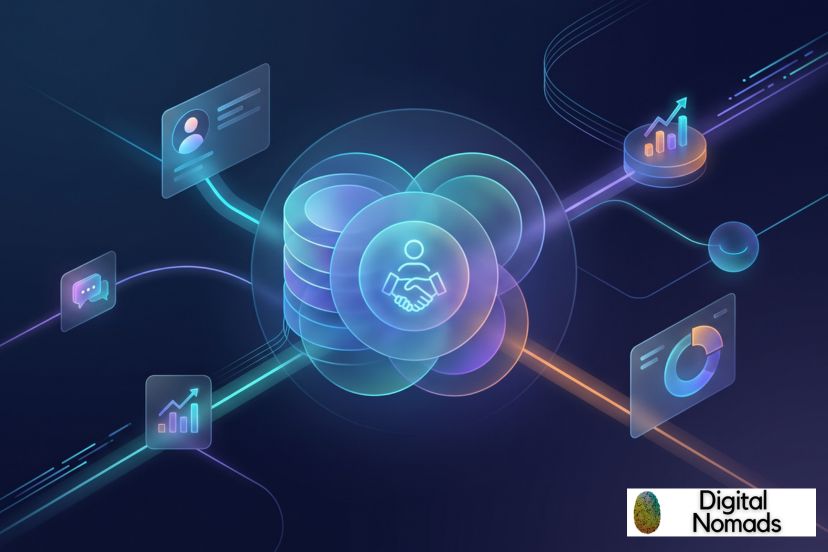

The AI Signal Problem: Google’s AI Is Only as Smart as Your Conversion Data
Google’s automated bidding optimises towards the conversion actions you mark as primary. Google Ads Help is explicit that primary actions are used for bidding, while secondary actions are for observation only. Tell the system a form submission is the goal and it will find the cheapest form submissions available: the student asking about a job, the competitor requesting a brochure, the searcher whose loosely related, bilingual query never signalled intent to buy. Broad Match widens that net further.
The upside of AI is real, but so is the cost of getting it wrong. A March 2026 analysis by Smarter Ecommerce of more than 250 ecommerce-focused AI Max campaigns, covered by Search Engine Journal, found a median 13% lift in conversion value. However, the extra conversions cost more than baseline keyword traffic, with ALM Corp’s write-up putting the rise in cost per acquisition at around 16%. In other words, AI Max does find additional demand, but it counts whatever you defined as a conversion. If the definition is weak, AI Max scales the weakness.
Recently, we activated the AI Max for Search feature for a local education provider in Hong Kong. Within just one month of activation, the cost per lead (CPL) decreased by 15%, while the overall conversion rate increased significantly as Google’s AI tapped into broader search queries that traditional exact and phrase match keywords were missing. The practical takeaway for local marketers is clear: AI Max can dramatically improve campaign efficiency and scale qualified lead volume, provided your account already has a strong base of clean conversion signals to guide the bidding algorithm.
The 17 August 2026 bidding change raises the stakes. Budget-limited Target CPA and Target ROAS campaigns now track their stated targets far more closely instead of quietly overperforming. According to our evaluation, establishing a target based on low-cost leads will ultimately result in receiving low-quality leads.
What we do instead:
- Keep one to three primary actions, as close to revenue as you can reliably measure.
- Downgrade micro-actions such as page views, button clicks and form starts to secondary.
- Promote “qualified lead” to primary once there is enough volume for the algorithm to learn from.
- Settle all of this before activating AI Max, never after.
Then ask your sales team which leads were junk, and compare them with your search terms report. That feedback is the start of a real signal. This is the foundation of Google Ads conversion optimisation in Hong Kong: decide what a good lead is before asking a machine to find more of them.

High-Converting Landing Page Architecture
A brochure page tells your story. A direct-response page earns one action. The distinction becomes evident across four key areas:
Message match. The headline repeats the promise that earned the click. Landing page experience feeds into Google’s Ad Rank, so relevance lowers your costs as well as lifting conversions.
Speed. Google’s mobile research estimates that the probability of a bounce is 32% higher when a page takes three seconds to load instead of one, as summarised in Think with Google’s Milliseconds Make Millions report. Hong Kong visitors arrive on phones, often between MTR stops, so heavy sliders, autoplay video and stacked scripts cost you leads.
CDN performance. Implementing a robust content delivery network (CDN) like Cloudflare significantly reduces server response times and speeds up page loads for global and regional traffic. By caching static assets closer to users, edge delivery minimises latency, reduces bounce rates, and boosts overall site engagement.
Trust. Named clients, partner certifications, genuine reviews, a real address, and a visible phone or WhatsApp button, in English and Traditional Chinese where your audience needs both.
One action. Remove the navigation menu, ask for the fewest fields you can afford, and give every section the same next step.
The commercial effect is measurable. When high-intent campaign structures are aligned directly with post-click UX/UI refinements and a streamlined checkout journey, businesses consistently see a dramatic lift in converted revenue. Eliminating checkout friction, clarifying conversion funnels, and matching landing page messaging to search intent ensures that expanded ad reach translates directly into completed transactions and qualified leads. The overall result comes from fixing the acquisition channel and the user experience together, which is why we plan landing pages, conversion paths, and campaigns side by side through our web development work.

Frictionless Lead Capture: WhatsApp or Qualifying Form?
Not every high-intent searcher prefers filling out a web form. A Meta-commissioned Kantar survey of 500 Hong Kong adults in July 2024, reported by The Standard, found that 71% engage with businesses on WhatsApp at least once a week. Close to half said it was their preferred way to contact a business, ahead of email (29%) and phone calls (28%). That is why the Google Ads WhatsApp asset deserves more attention than it gets, as we explain in our Google Ads and WhatsApp guide.
A simple rule of thumb:
- Choose WhatsApp when the buyer decides quickly and values a fast answer: clinics, salons, tutoring, home services, retail and hospitality. Speed of reply beats depth of information.
- Choose a qualifying form when the sale is considered and expensive: professional services, corporate training, B2B software. In a B2B lead generation funnel, the form is the first filter, not just the first contact. Budget, timeline and company size tell sales whom to call first.
- Combine both when you need speed and qualification: a short form followed by an automatic WhatsApp confirmation, or a chat that opens with two qualifying questions.
One tracking issue: when prospects message you on WhatsApp, standard setups lose sight of which ad drove the lead. Instead of only counting clicks, connect your Google Ads WhatsApp Message Asset to a platform like WATI. WATI automatically tags incoming Google Ads chats, runs an early qualification flow (collecting name, email, and intent under your privacy notice), and pushes qualified lead and purchase events directly back into Google Ads for Smart Bidding optimisation.

Closing the Loop: Offline Conversion Tracking in Google Ads
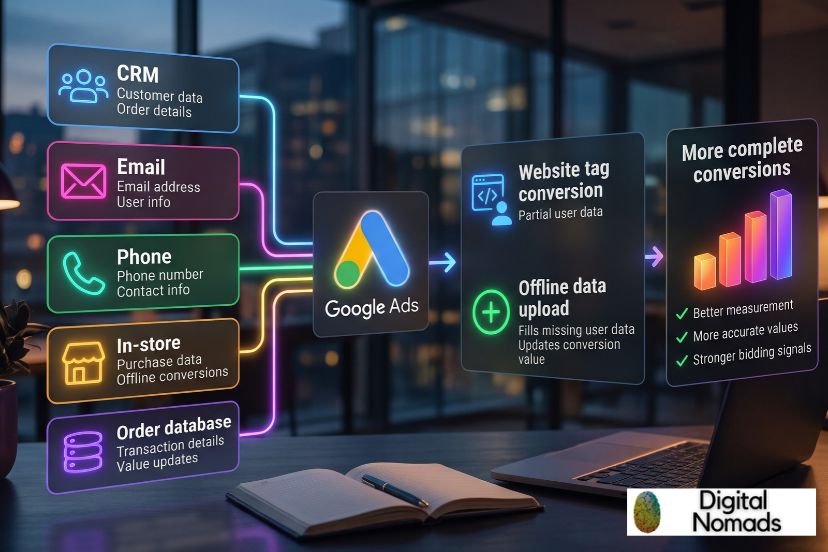
The strongest signal you can give Google’s AI is revenue. Offline conversion tracking in Google Ads sends what happens after the enquiry (lead qualified, proposal sent, contract signed) back to the click that started it. Map your B2B lead generation funnel to conversion actions: enquiry, qualified lead, opportunity, won client. Keep the first as secondary, make the middle stage primary, and attach revenue to the last.
Google now recommends upgrading offline imports to enhanced conversions for leads. You supply customer data (at least one of email, phone number or address), hashed with SHA-256, plus a conversion name and time. You also supply the Google click ID if you aren’t using Google’s tag to collect that data on your site. Google’s own best practice is to set the goal as “Qualified lead” or “Converted lead”. As Google explains, the hashed data is matched against information collected on your website and against signed-in Google accounts that engaged with your ad. That is why your lead form must capture an email or phone number, and why auto-tagging has to be on.
Then add value. Assign your funnel milestones a value based on how often they close. As an illustration, if one in ten qualified leads becomes a client and the average job is worth HKD 20,000 a qualified lead is worth about HKD 2,000. Feed those values into Maximise Conversion Value or Target ROAS and the algorithm stops hunting cheap form fills and starts hunting the searches that produce paying clients. If your sales cycle is long, optimise for an earlier milestone such as ‘qualified’ or ‘meeting booked’, so the signal reaches Google with enough speed and volume to still be useful.
In our experience, assigning specific conversion values is often the trickiest step. Many of the businesses we advise lack concrete data on their lead qualification-to-activation rates, and they rarely perform granular, channel-by-channel customer lifetime value analysis. If you haven’t conducted this level of in-depth analytics, it is best to set the conversion value to zero (or leave it unassigned) and rely on target cost-per-lead (tCPA) or Maximise Conversions bidding strategies instead.
Where to Start
- Audit which conversions are primary and downgrade the rest.
- Rebuild one landing page around one action.
- Choose WhatsApp, a qualifying form, or both for each campaign.
- Connect your CRM and import qualified leads and sales.
Kick-off your AI Enhanced Google Ads
Ready to turn your search campaigns into predictable revenue? Request a free strategy consultation with our team. We will perform an in-depth audit of your Google Ads account, audit your conversion tracking setup, and pinpoint high-value lead signals that drive actual sales rather than wasted ad spend.
Frequently Asked Questions.
What is AI search marketing, and how does it change Google Ads management in Hong Kong?
AI search marketing means running search campaigns where Google’s AI makes more of the decisions, through features such as Broad Match, Smart Bidding and AI Max, alongside answers shown in AI Overviews. Instead of managing individual keywords and bids, you steer the system with the signals you supply: your conversion actions, assets and landing pages. Google handles around 89% of Hong Kong searches, so the quality of those signals is the main lever you control.
Why does my Google Ads account generate enquiries that never become clients?
Usually because the conversion you told Google to optimise towards is too easy, such as a basic form submission. Smart Bidding then finds the cheapest form fills it can, including job-seekers, students and competitors. The fix is to define what a qualified lead is, demote micro-actions to secondary, and send qualified leads back from your CRM so the AI learns from real outcomes.
What is the difference between primary and secondary conversions in Google Ads?
According to Google Ads Help, primary conversion actions appear in the “Conversions” column and are used for bidding, whilst secondary actions are for observation only and appear in “All conversions”. The exception is actions included in a custom goal, which are used for bidding even if they are marked secondary. We recommend keeping primary actions to one to three, as close to revenue as you can reliably measure.
What is offline conversion tracking in Google Ads?
Offline conversion tracking sends outcomes that happen after the website enquiry, such as “lead qualified” or “contract signed”, back to Google Ads and credits them to the click that started the journey. Google recommends upgrading to enhanced conversions for leads, which adds hashed customer data (email, phone number or address) to improve accuracy and bidding performance. It requires auto-tagging and a lead form that captures an email or phone number.
How do I turn a B2B lead generation funnel into conversion values for Google Ads?
Then value each stage by how often it closes. As an illustration, if one in ten qualified leads becomes a client and the average job is worth HK 20,000, a qualified lead is worth about HK 2,000. Feed those values into Maximise Conversion Value or Target ROAS, so the algorithm optimises for revenue rather than enquiry volume. For long sales cycles, import an earlier stage so the signal arrives in time.
Should I send Google Ads traffic to WhatsApp or a lead form?
WhatsApp suits fast decisions where a quick reply wins, such as clinics, salons, tutoring and home services. Research reported by The Standard found that around seven in ten Hong Kong consumers message businesses on WhatsApp at least weekly. A qualifying form suits expensive, considered sales where budget and timeline matter. Many advertisers combine both: a short form followed by an automatic WhatsApp confirmation.
How fast does a landing page need to load for Google Ads?
As fast as you can make it on mobile. Google’s research estimates that the probability of a bounce is 32% higher when a page takes three seconds to load rather than one. Heavy images, autoplay video and unnecessary scripts are the usual causes, so test on a real phone over mobile data rather than only on office Wi-Fi.