
Hong Kong’s digital retail landscape is evolving at a breakneck pace. As of 2026, the local e-commerce market is projected to reach an impressive USD 28.47 billion, advancing at a compound annual growth rate (CAGR) of nearly 7.9% towards a staggering USD 41.62 billion by 2031, according to data from Mordor Intelligence and Research and Markets.
With government initiatives like the “E-commerce Easy” BUD Fund offering grants up to HKD 1 million to support digital migration, there has never been a better time for local SMEs to launch or upgrade their online stores. But when it comes to building your digital storefront, a critical decision awaits: Shopify or WooCommerce?
Both platforms power millions of websites globally, but localising your choice for the Hong Kong market requires looking at specific factors like regional payment gateways (FPS, PayMe, AlipayHK), local logistics (SF Express, Lalamove), and mobile-first performance.
In this guide, we will break down the pros and cons of WooCommerce versus Shopify, helping Hong Kong merchants make an informed, data-driven decision.
The Hong Kong E-commerce Landscape: Setting the Scene
Before diving into the platforms, it is crucial to understand how Hong Kong consumers are shopping in 2026.
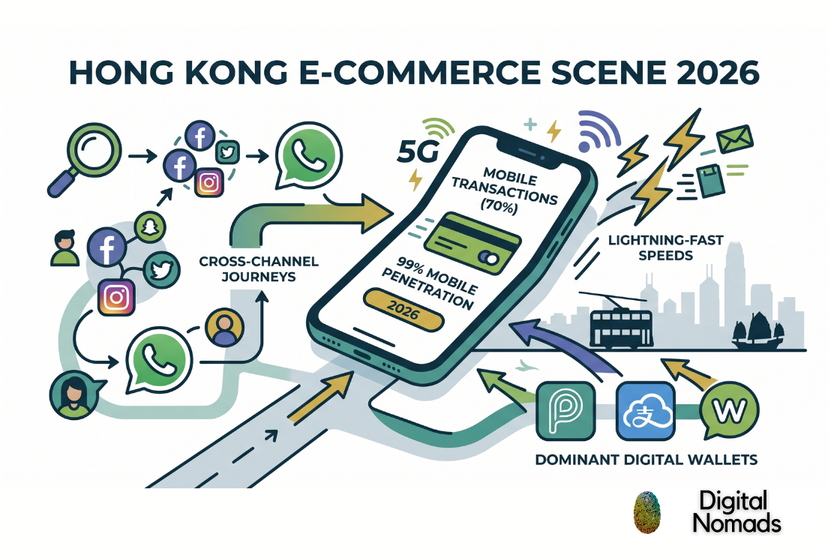
- Mobile is King: With a 99% smartphone penetration rate and widespread 5G roll-outs, mobile commerce now accounts for nearly 70% of total e-commerce transactions in the city (Mordor Intelligence, 2026). Your chosen platform must deliver lightning-fast mobile speeds.
- Digital Wallets Dominate: While credit cards remain popular, digital wallets like WeChat Pay, AlipayHK, and PayMe are the fastest-growing payment methods, capturing a massive share of the market.
- Cross-Channel Journeys: Consumers do not just search; they interact via WhatsApp and social media before buying. In fact, 70% of local shoppers get in touch at least once a week with a local business through this messaging app (Meta research).
With these statistics in mind, let us evaluate how Shopify and WooCommerce measure up.
Shopify: The Hosted E-commerce Powerhouse
Shopify is a fully hosted, software-as-a-service (SaaS) platform. This means you pay a monthly subscription, and Shopify takes care of the hosting, security, and technical maintenance.
Pros of Using Shopify in Hong Kong
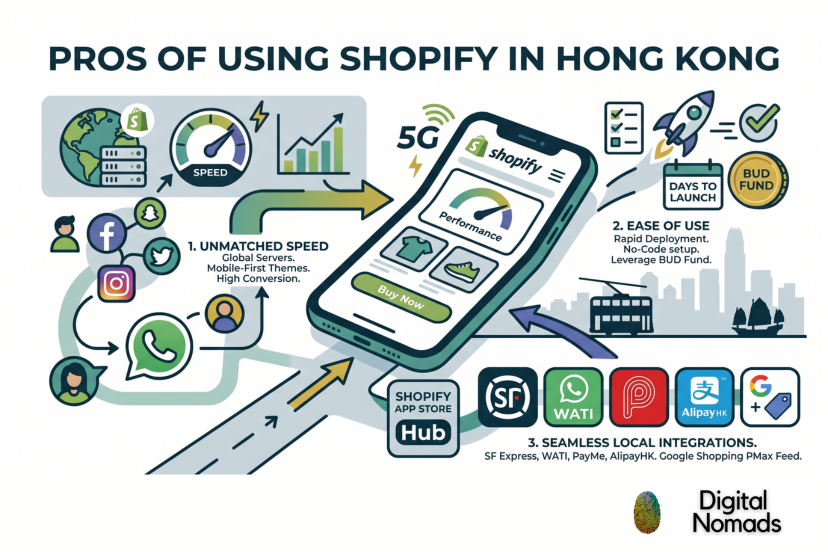
- Unmatched Speed and Mobile Optimisation Because Shopify handles the hosting on their global servers, your website is practically guaranteed to load quickly. Given that Hong Kong shoppers are overwhelmingly mobile-first, Shopify’s thumb-friendly, fast-loading themes are a massive advantage for conversion rates.
- Ease of Use and Rapid Deployment For businesses looking to quickly capitalise on government funding schemes like the BUD Fund, Shopify offers the fastest route to market. You can set up a professional-looking store in a matter of days without needing to write a single line of code.
- Seamless Local Integrations The Shopify App Store is incredibly robust. Integrating local favourites like SF Express for shipping, WATI for WhatsApp communications, or connecting third-party gateways to accept PayMe and AlipayHK is usually a matter of installing an app. Furthermore, Shopify seamlessly integrates with product feeds for Shopping Ads in Hong Kong, allowing you to leverage Google’s AI-driven Performance Max campaigns effortlessly.
Cons of Using Shopify
- Recurring Costs and Transaction Fees Shopify’s convenience comes at a price. Alongside your monthly subscription (which increases as you scale), you must pay for premium themes and apps. More importantly, if you do not use Shopify Payments (which currently lacks native support for some niche local wallets without third-party workarounds), you will incur additional transaction fees on every sale.
- Limited SEO Customisation While Shopify is decent for basic SEO, it has rigid URL structures (e.g., forcing /products/ or /collections/ into your URLs) and limited access to the server environment. If you want to deploy an advanced SEO strategy in Hong Kong to outrank fierce local competition, these technical limitations can occasionally be frustrating.
WooCommerce: The Open-Source Titan
WooCommerce is an open-source plugin built on top of WordPress. It is completely free to download, but you are responsible for your own web hosting, domain name, security, and maintenance.
Pros of Using WooCommerce in Hong Kong
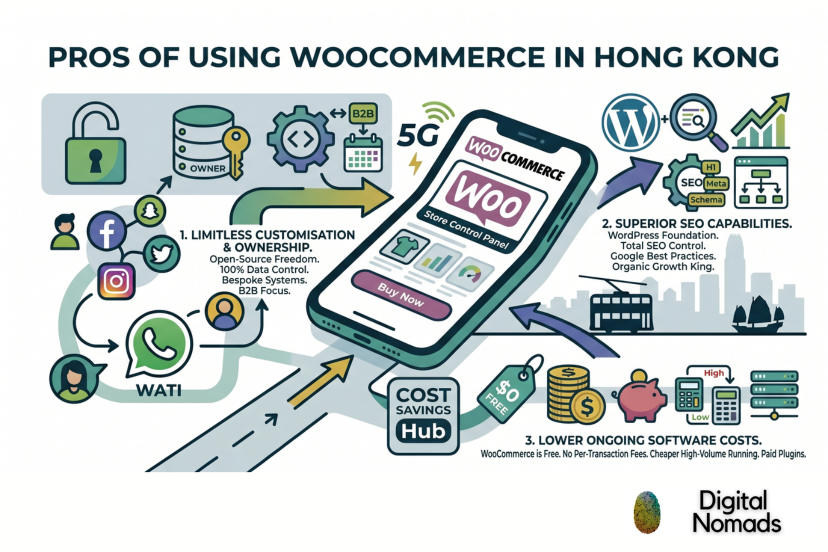
- Limitless Customisation and Ownership Because WooCommerce is open-source, you own your store and its data 100%. If you have a unique business model, require bespoke booking systems, or want a highly specific checkout flow for Hong Kong B2B clients, WooCommerce can be customised to do exactly what you want.
- Superior SEO Capabilities WordPress is fundamentally a blogging and content platform, making it the undisputed king of SEO. With WooCommerce, you have total control over your URL structures, meta tags, schema markup, and site architecture. For businesses relying on organic traffic, following a comprehensive Google SEO Best Practices Guide for Ecommerce is much easier to execute technically on WooCommerce than on Shopify.
- Lower Ongoing Software Costs WooCommerce itself is free, and it does not charge transaction fees. While you will pay for hosting and premium plugins, a well-optimised WooCommerce store can be significantly cheaper to run at a high volume than a top-tier Shopify plan.
Cons of Using WooCommerce
- Technical Maintenance With great power comes great responsibility. You (or your web agency) must manage software updates, plugin compatibility, security patches, and server performance. If a plugin update breaks your checkout during a high-traffic holiday sale, the responsibility to fix it lies entirely with you.
- Hosting Speed Variables Unlike Shopify’s guaranteed server speeds, a WooCommerce site is only as fast as its hosting provider. To cater to Hong Kong’s fast-paced mobile shoppers, you will need to invest in premium, managed WordPress hosting (ideally with servers located in Hong Kong or Singapore) to prevent slow page load times.
The Verdict: Which Platform Should You Choose?
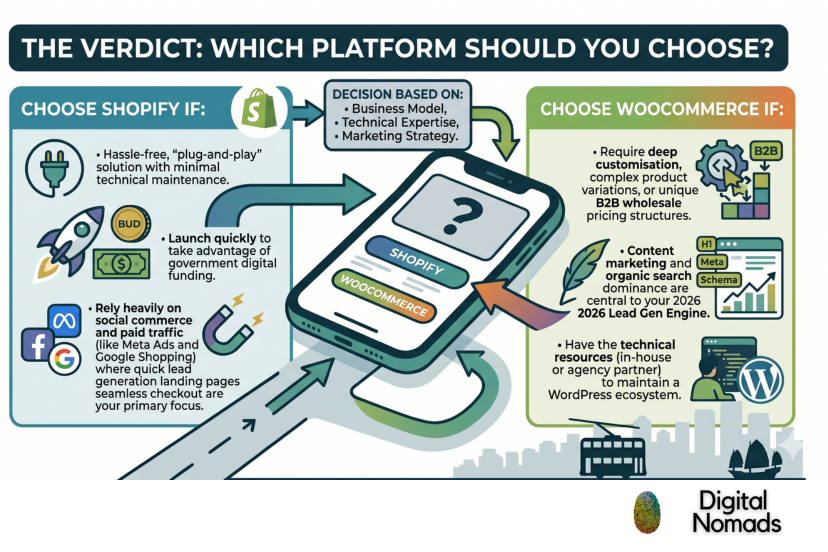
The decision between Shopify and WooCommerce ultimately comes down to your business model, technical expertise, and marketing strategy.
Choose Shopify if:
- You want a hassle-free, “plug-and-play” solution with minimal technical maintenance.
- You want to launch quickly to take advantage of government digital funding.
- You rely heavily on social commerce and paid traffic (like Meta Ads and Google Shopping) where quick lead generation landing pages and seamless checkout are your primary focus.
Choose WooCommerce if:
- You require deep customisation, complex product variations, or unique B2B wholesale pricing structures.
- Content marketing and organic search dominance are central to your 2026 Lead Gen Engine.
- You have the technical resources (in-house or agency partner) to maintain a WordPress ecosystem.
Don’t Forget the Funnel
Regardless of whether you choose Shopify or WooCommerce, the platform is just the foundation. In Hong Kong’s hyper-competitive 2026 market, traffic is the lifeblood of your store.
To truly succeed, you need to integrate your chosen platform into a holistic marketing strategy. This means leveraging AI-driven search campaigns and capturing the local market where they spend their time. For instance, combining your e-commerce data with conversational commerce is proving to be a game-changer. Learn more about how you can create this synergy in our guide to Building a Google Ads & WhatsApp Funnel for Growth.
Are you planning to launch or migrate your Hong Kong e-commerce store but feel overwhelmed by the technical SEO and paid advertising requirements? At Digital Nomads Hong Kong, we specialise in driving highly qualified traffic to both Shopify and WooCommerce platforms. Contact us today to see how we can help you turn your online store into a revenue-generating machine.